


The Puzzle of the Missing Miniatures
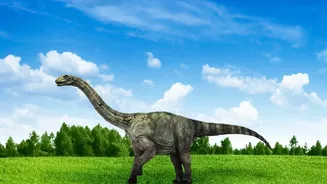
For over 150 million years, dinosaurs dominated the planet, evolving into an astonishing array of shapes and sizes. We marvel at the colossal Argentinosaurus and fear the mighty T. rex. Yet, amidst this diversity, there's a strange gap in the fossil record
that has long puzzled palaeontologists: the absence of genuinely tiny dinosaurs. While today's ecosystems are filled with small creatures like mice, shrews, and hummingbirds, the smallest known non-avian dinosaurs were relative giants. Even the most diminutive ones, like Microraptor, weighed around 450 grams—roughly the size of a large rabbit. This is hundreds of times heavier than the smallest mammals and birds living today. It's a biological mystery because, in most animal groups, smaller species are far more common than larger ones. So, where are all the mouse-sized dinosaurs?
An Unexpected Answer in the Ecosystem
For years, scientists have explored various biological reasons for this phenomenon. Perhaps there was something in dinosaur physiology that prevented them from shrinking. But a new study, published in the journal Evolution by researchers from Princeton University and the American Museum of Natural History, offers a different and compelling explanation: it wasn't about the dinosaurs themselves, but about their competition. The study used sophisticated mathematical models based on how animals use energy to predict the optimal body sizes that natural selection should favour. While these models accurately predicted the size ranges for mammals, birds, and turtles, they failed when applied to non-bird dinosaurs. No matter how the researchers tweaked the biological parameters, the models suggested tiny dinosaurs should have existed. Their absence pointed to an external, ecological pressure.
The Reign of the Small Mammals
The new explanation flips a long-held idea on its head. It’s widely accepted that the dominance of giant dinosaurs kept early mammals small, confining them to the shadows of the Mesozoic Era. This new research suggests the reverse was also true: these small, shrew-like mammals were so successful in their tiny ecological niches that they effectively blocked dinosaurs from evolving into smaller forms. Our furry ancestors were likely fierce competitors for the insects and seeds that a mouse-sized dinosaur would have needed to survive. Essentially, while dinosaurs ruled the day at larger sizes, the world of the very small was already a crowded and competitive space, dominated by mammals. Dinosaurs couldn't get a foothold in the market for tiny life forms.
How Birds Broke the Size Barrier
This theory also helps explain one of the greatest success stories in evolution: the birds. Birds are direct descendants of dinosaurs, yet they shattered the size barrier that constrained their relatives. The smallest bird today, the bee hummingbird, weighs less than two grams. How did they manage this incredible feat of miniaturization? The study proposes that the evolution of flight was the key. By taking to the skies, early birds could access entirely new food sources and escape ground-level competition with mammals. This new, aerial niche was wide open, allowing them to rapidly evolve into smaller and smaller sizes, a process that had already begun in their dinosaur ancestors but accelerated dramatically with flight. Flight gave them an escape route from the ecological pressures that kept other dinosaurs large.
Rethinking the Age of Dinosaurs
This new perspective doesn't just solve the puzzle of the missing tiny dinosaurs; it paints a more complex picture of the ecosystems they lived in. It challenges the simple narrative of dinosaurs as the undisputed rulers of their time. Instead, it reveals a world with intricate ecological dynamics, where giant dinosaurs shared the planet with a thriving population of small mammals that were not just hiding but were actively shaping the evolutionary paths of the titans around them. It suggests that the path to becoming big or small isn't just about an animal's own biology but is powerfully influenced by the other creatures sharing its environment. The story of dinosaur size is, it turns out, also a story about everyone else.