






An Unexpected Glimmer of Hope
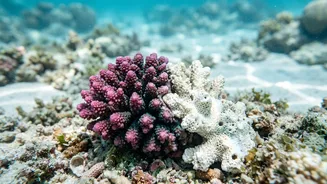
The finding, like many great scientific discoveries, started by accident. In a lab at Stanford University, a researcher noticed a bleached, white coral fragment had fallen against a healthy one from the same colony. Where the two touched, the colour was
starting to return to the bleached piece. This observation sparked a formal experiment which confirmed that when healthy and bleached corals from the same colony are in direct contact, they can fuse their tissues. This fusion creates microscopic channels, allowing the healthy coral to transfer vital algae to its struggling neighbour, kick-starting a rapid recovery process.
The Science of Symbiosis and Bleaching
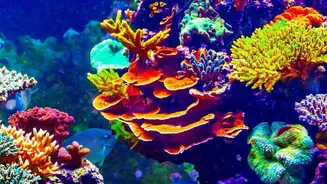
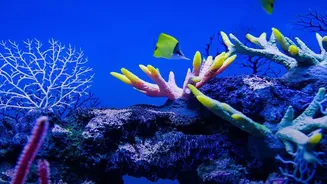
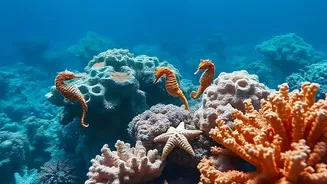
To understand why this is so significant, it's important to know how corals live. Corals are animals, made up of tiny polyps. Inside their tissues, they host microscopic algae called zooxanthellae. This is a classic symbiotic relationship: the coral provides the algae with a protected home, and the algae perform photosynthesis, supplying the coral with up to 90% of its food and energy. This partnership is what gives corals their brilliant colours. But when ocean temperatures rise by as little as one degree Celsius for a few weeks, corals become stressed and expel these algae. This is coral bleaching. The coral isn't dead yet, but without its primary food source, it turns white and is vulnerable to starvation and disease.
How the 'Donation' Process Works
The laboratory experiments showed that when genetically identical fragments touch, their tissues recognize each other and fuse. Within just three days, algae begin to move across this living bridge from the healthy coral to the bleached one. Remarkably, the transferred algae then multiply at an astonishing rate inside their new host, doubling their population roughly every four days—about ten times faster than normal. The study found that only about a week of contact was needed to transfer enough algae for a full recovery, which took about seven to eight weeks in total. Even after being separated, the once-bleached fragment continued to heal and regain its colour on its own.
New Possibilities for Reef Restoration
This discovery opens up exciting new possibilities for coral reef restoration. Current methods often involve growing coral fragments in nurseries and then transplanting them onto damaged reefs, a costly and labor intensive process. This new finding suggests that strategically placing healthy, genetically identical coral fragments next to bleached ones could accelerate natural recovery. This could be a powerful tool to help reefs survive increasingly frequent marine heatwaves. By 'seeding' a bleached area with healthy donor corals, conservationists could potentially trigger a cascade of recovery that might otherwise take years, if it happens at all.
A Realistic Perspective Is Crucial
While this is a promising breakthrough, it is not a silver bullet for the coral bleaching crisis. The key limitation is that the process only works between genetically identical corals. Fragments from different colonies did not fuse; in some cases, they competed with each other. Applying this on a massive scale across vast, genetically diverse reefs is not currently feasible. Scientists stress that this technique is a tool to help buy time, not a solution to the underlying problem. The primary driver of mass bleaching is climate change and the resulting rise in ocean temperatures. Without aggressive global action to reduce greenhouse gas emissions, even the most innovative restoration techniques will be overwhelmed.