





A World Reimagined
For decades, Pluto was little more than a fuzzy dot in our most powerful telescopes. It was considered the final, frozen outpost of the classical solar system. That all changed in 2015 when NASA's New Horizons spacecraft flew by, revealing a world of stunning
complexity, with towering mountains of water ice and vast plains of frozen nitrogen. The mission’s centrepiece was Tombaugh Regio, a bright, heart-shaped feature. The western lobe of this heart, a huge basin named Sputnik Planitia, proved to be one of the most fascinating surfaces in the solar system. It was almost entirely free of impact craters, suggesting its surface was incredibly young and constantly being renewed.
The Telltale Signs of Liquid
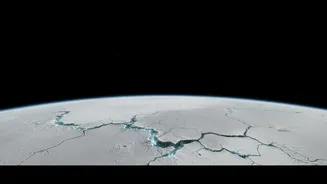
Now, more than a decade after the flyby, scientists are still making discoveries from the treasure trove of New Horizons data. A new study published in the Planetary Science Journal focuses on dark streaks and patches observed at the northern edge of Sputnik Planitia. Researchers propose these features are evidence of liquid nitrogen seeping up from below the surface and temporarily 'wetting' the frozen landscape before refreezing. This hypothesis arose after comparing the features on Pluto to satellite images of Greenland's ice sheet, where meltwater creates similar-looking dark patterns on snow and ice. While not definitive proof, this comparative analysis provides a compelling explanation for the mysterious markings on Pluto.
How to Get Liquid on a Frozen World
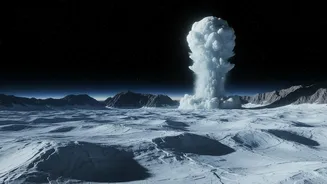
The idea of liquid on Pluto, where surface temperatures hover around a frigid -230 degrees Celsius, seems impossible. Liquid nitrogen rain is physically impossible under Pluto's thin atmosphere. Instead, scientists propose a process akin to cryovolcanism, or ice volcanoes. The theory is that heat radiating from Pluto's rocky core could be just enough to melt the nitrogen ice at the base of the Sputnik Planitia glacier, which is several kilometres deep. Because liquid nitrogen is less dense than solid nitrogen ice, it would become buoyant. This liquid could then collect in reservoirs before erupting upwards through cracks and fissures in the ice sheet, briefly flowing across the surface before freezing again. These eruptions would likely happen in short, intense pulses.
The Legacy of New Horizons
This discovery underscores the immense value of the New Horizons mission. A single, brief flyby has provided enough data to keep planetary scientists busy for decades, fundamentally rewriting our understanding of the outer solar system. The mission, led by principal investigator Alan Stern of the Southwest Research Institute, has shown that small, cold worlds can be surprisingly active. "Pluto never stops surprising us," Stern said in a statement about the new findings. These discoveries suggest that Pluto is not a dead world but a dynamic one, with ongoing geological processes that continue to shape its landscape.
A New Class of World
The implications of this study extend far beyond Pluto itself. If a dwarf planet so far from the sun can generate enough internal heat to sustain subsurface liquids and geological activity, what does that mean for other bodies in the Kuiper Belt? This process could help explain features seen on other distant worlds, like Neptune's moon Triton, and raises the possibility that other dwarf planets like Eris could also be geologically active. It suggests that the ingredients for dynamic worlds—heat, rock, and exotic ices—are more common in the cosmos than previously thought, opening up a new chapter in our exploration of the solar system's hidden depths.