




The Midnight Hour
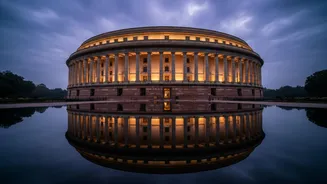
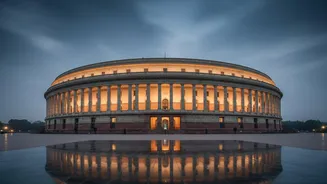
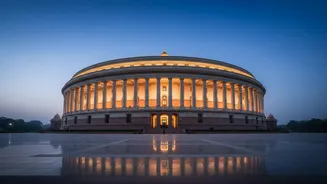
The formal birth of independent India happened in the Constituent Assembly hall in New Delhi. As the clock ticked towards midnight on August 14, Jawaharlal Nehru, soon to be the country's first Prime Minister, delivered his immortal "Tryst with Destiny"
speech. He spoke of a pledge made long ago, a promise to be redeemed "not wholly or in full measure, but very substantially." His words, broadcast to the nation, captured the profound weight of the moment: the end of an era and the dawn of another, all while acknowledging the sorrow of Partition that accompanied freedom. The session was chaired by Dr. Rajendra Prasad, and Lord Mountbatten, the last British Viceroy, was appointed the first Governor-General of the new Dominion of India. As Nehru finished, the transfer of power became official, and India, after centuries of foreign rule, was finally its own master.
A Sea of Humanity
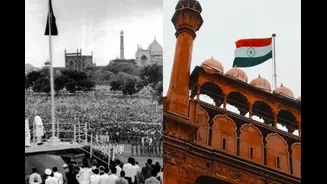
While the formalities took place indoors, the streets of Delhi belonged to the people. An ocean of humanity, estimated to be over half a million strong, surged through the capital. Arrangements made for a crowd of 30,000 at the flag hoisting ceremony at Princes Park (near India Gate) were completely overwhelmed. Police cordons were broken as joyous, celebrating citizens took possession of the day. The carefully rehearsed ceremonies had to be abandoned in the face of spontaneous and overwhelming public happiness. The mood was ecstatic and good-humoured. The crowds were so dense that Lord and Lady Mountbatten, driving in their state coach, were met with thunderous cheers of "Mountbatten Zindabad," a reception unlike any previous Governor-General had received. This mass participation transformed a state event into a people's festival, a collective expression of a dream fulfilled.
The Tricolour at the Red Fort
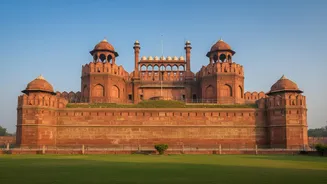
The most enduring image of that period came on August 16, 1947. While a flag hoisting did occur on August 15 at Princes Park, the iconic ceremony at the Red Fort took place the following day. Jawaharlal Nehru, now Prime Minister, raised the Indian national Tricolour over the Lahori Gate of the fort, a powerful symbol of Mughal-era sovereignty now reclaimed by a new, democratic India. Addressing the nation from its ramparts, Nehru declared, "This flag does not symbolize the triumph of individuals or the Congress but the triumph of the whole country." The choice of the Red Fort was deeply symbolic; it was the seat of past empires and had recently hosted the controversial INA trials, making its selection a potent statement of reclaimed national pride. This act established a tradition that continues to this day, with every subsequent Prime Minister hoisting the flag and addressing the nation from the same spot each Independence Day.
A Day of Joy and Sombre Reality
The celebrations were euphoric, but they could not entirely mask the grim reality of Partition. The division of British India into India and Pakistan had been accompanied by horrific violence and one of the largest mass migrations in history. Even as Nehru spoke of destiny, his heart and those of his colleagues were heavy with the memory of this sorrow. Mahatma Gandhi, the architect of India's freedom, was notably absent from the celebrations in Delhi. He remained in Calcutta, fasting and praying in an attempt to quell the communal riots that had engulfed the region. Lord Mountbatten himself noted Gandhi's absence in his address, acknowledging the debt the nation owed him. This blend of joy and sorrow, of triumph and tragedy, defined India's first taste of freedom, a complex inheritance that the new nation would carry into its future.