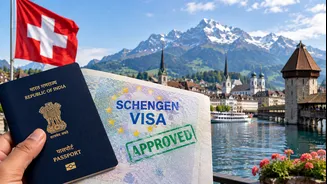








As Europe remains a top travel destination for Indians, demand for the coveted Schengen visa is at an all-time high. But the latest data reveals a crucial fact: where you apply from India can dramatically alter your chances of success.
A Record Year for Indian Applicants
In 2025, Indian
travellers filed more than 1.15 million applications for a short-stay Schengen visa, making India the third-largest applicant country in the world, just behind China and Turkey. This surge reflects a growing appetite for European travel among Indians for tourism, business, and family visits. However, of these applications, over 181,000 were rejected. This translates to an overall rejection rate of 15.8%, meaning roughly one in every six Indian applicants was denied a visa. This rate is slightly higher than the global average, which hovered around 14.8% for the same period.
A Tale of Two Europes: The Rejection Rate Lottery
The 15.8% average rejection rate masks a massive disparity between individual Schengen member states. For Indian applicants, getting a visa can feel like a geographical lottery. Some countries show remarkably high approval rates, while others deny a significant portion of applications. For instance, Slovenia had the highest rejection rate for Indian applicants in 2025, denying a staggering 46.1% of applications. Other countries with challenging approval odds included Bulgaria (37%), Greece (33%), Malta (31.7%), and Estonia (30.1%). This means that an application to one of these embassies was statistically far less likely to succeed than an application elsewhere.
Where Are The Doors More Open?
On the other end of the spectrum, several countries demonstrated much more favourable outcomes for Indian passport holders. Denmark had the lowest rejection rate in 2025 at just 6.9%. It was followed by Belgium with a 7.7% rejection rate. Germany, despite its reputation for being strict, proved to be a reliable option. It processed over 153,000 applications from India—the third-highest volume—and maintained a relatively low rejection rate of 10.5%. Switzerland, the most popular destination for Indian applicants by volume, had a rejection rate of 13.6%, which is still below the overall average.
Why Such a Wide Gap in Approvals?
Several factors contribute to these uneven outcomes. Consulates that handle a smaller volume of applications, like Malta's or Slovenia's, may see their rejection percentages swing dramatically with even a small number of problematic files. Conversely, high-volume embassies like Germany's are well-oiled machines, processing thousands of applications with established criteria. The most common reasons cited for rejection are universal: incomplete or inconsistent documentation, insufficient proof of funds, questionable travel itineraries with unverified hotel or flight bookings, and a failure to prove strong ties to India, leading to doubts about the applicant's intent to return home. Some experts suggest that applications submitted during peak season may also face stricter scrutiny as visa officers handle immense backlogs.
How Should Applicants Navigate This?
The data might tempt travellers to apply to the country with the lowest rejection rate, but this is a mistake. Schengen rules are clear and non-negotiable: you must apply to the consulate of your main destination, which is the country where you will spend the most nights. If you plan to spend equal time in two countries, you apply to the one you will enter first. Applying to the 'wrong' embassy is a reason for rejection in itself. The key takeaway from the data is not to game the system, but to be exceptionally diligent. A strong, well-documented application submitted to the correct consulate is far more important than any country's average approval rate. This includes providing verifiable bookings, clear financial records, and a coherent itinerary that leaves no room for doubt.