




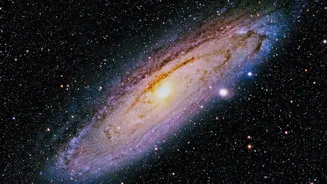
A Flash in the Galactic Night
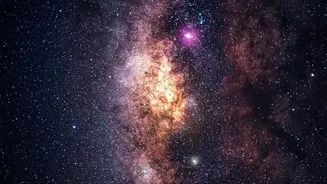
Deep in our own Milky Way galaxy, a powerful and enigmatic glow of high-energy light has captured the attention of astronomers. Observatories like China's Large High Altitude Air Shower Observatory (LHAASO) are designed to detect such phenomena. These
facilities don't see the light directly but instead observe the cascade of secondary particles created when ultra-high-energy gamma rays slam into Earth's atmosphere. The signal in question is believed to be the remnant of a colossal explosion that may have occurred less than 1,000 years ago, making it a relatively recent event in cosmic terms. The brightness and small size of the glowing cloud suggest it's a young remnant.
Decoding the Cosmic Light
The light detected is in the form of gamma rays, the most energetic form of light in the universe. These are not the gentle photons of visible starlight; a single gamma-ray burst can release more energy in seconds than our Sun will in its entire lifetime. Events powerful enough to create this light are among the most violent in the cosmos. Scientists have been working for decades to understand their origins, which were first detected by satellites monitoring for nuclear tests in the 1960s. Today, advanced observatories can detect ultra-high-energy gamma rays with energies measured in Teraelectronvolts (TeV) or even Petaelectronvolts (PeV)—a quadrillion electron volts—which points to an extreme particle accelerator at the source.
When Dead Stars Collide
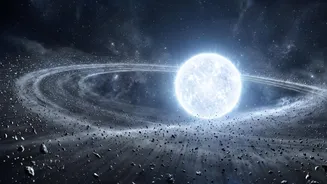
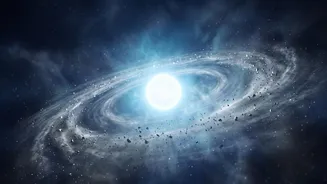
The leading hypothesis for what caused this high-energy glow is a cosmic merger, specifically the collision of two neutron stars. Neutron stars are the incredibly dense collapsed cores left behind after massive stars explode in supernovas. A single teaspoon of neutron star material would weigh about a billion tonnes. In some binary systems, two of these stellar remnants orbit each other, gradually spiraling closer over millions of years as they shed energy through gravitational waves. Eventually, they collide in a cataclysmic event known as a kilonova. This merger unleashes a tremendous blast of energy and matter, forging many of the universe's heaviest elements, including gold, platinum, and uranium.
Piecing Together the Evidence
The connection between this high-energy light and a stellar merger is built on decades of research. Astronomers have long theorized that neutron star mergers produce short, intense gamma-ray bursts (GRBs). This was confirmed spectacularly in 2017 with the event GW170817, where both gravitational waves and electromagnetic light from a single neutron star merger were detected for the first time, heralding a new era of multi-messenger astronomy. The recent observations in our galaxy provide more potential evidence, linking the afterglow of such an event to a source of ultra-high-energy gamma rays. Researchers believe that while the initial flash of the merger may have been brief, the ejected material continues to glow as it expands, powered by the radioactive decay of the newly formed heavy elements.
A New Window on the Universe
Confirming that a nearby kilonova remnant is the source of this high-energy light would be a major breakthrough. It would provide a local laboratory for studying the physics of the most extreme events in the universe and offer a direct look at a cosmic 'gold factory' at work. These discoveries challenge and refine existing theories about how particles are accelerated to such incredible energies, pushing the limits of our understanding. While the evidence strongly points to a neutron star merger, scientists are careful to note that further study is required to definitively confirm the source. Each new observation, however, adds another piece to the puzzle of how our galaxy was built and how the elements essential for life itself were forged in cosmic fire.