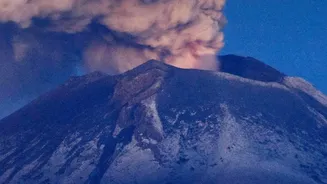



Hunga Tonga-Hunga Ha'apai, Tonga (2022)
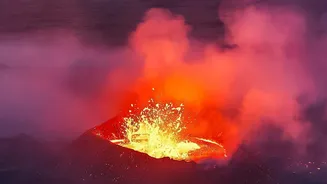
The eruption of the underwater Hunga Tonga-Hunga Ha’apai volcano on January 15, 2022, was a truly global event and the largest eruption of the 21st century. It was the biggest volcanic blast recorded with modern instruments, creating an atmospheric shockwave
that circled the planet multiple times. Heard as far away as Alaska, the explosion sent a plume of ash and water vapour an unprecedented 58 kilometres into the mesosphere, the highest volcanic plume ever recorded. This violent event triggered a devastating tsunami that impacted the surrounding Tongan islands, with some waves reaching staggering heights on uninhabited islands and causing fatalities as far away as Peru. The eruption was so powerful it was rated a VEI-5, comparable in strength to the 1991 eruption of Mount Pinatubo. Scientists continue to study the vast amount of data from the event, which injected a massive amount of water vapour into the stratosphere, an event whose long-term atmospheric consequences are still being understood.
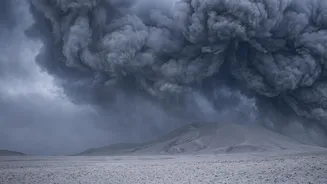
Eyjafjallajökull, Iceland (2010)
While not the largest eruption in terms of explosive power, the 2010 eruption of Iceland's Eyjafjallajökull volcano had an outsized impact on the modern world. When the volcano erupted beneath a glacier, the interaction of magma and ice water created a plume of very fine glass-like ash. This ash was then carried by the jet stream directly into some of the world's busiest airspace. The result was the largest shutdown of air traffic since World War II. For over six days, flights across Europe were grounded out of concern the abrasive ash particles would damage jet engines. Over 100,000 flights were cancelled, stranding an estimated 10 million passengers and costing the airline industry billions of dollars. The event served as a stark reminder of how a single, remote natural event could bring the highly interconnected global transport network to a grinding halt, forcing a complete rethink of aviation protocols for volcanic ash.
Mount Merapi, Indonesia (2010)
Later that same year, another eruption highlighted a different kind of volcanic threat. Mount Merapi, one of Indonesia's most active and dangerous volcanoes, began a series of violent eruptions in October 2010. Located in a densely populated region of Java, the danger was not from global disruption but from deadly, fast-moving pyroclastic flows—scorching clouds of gas and volcanic debris. These flows swept down the volcano's slopes, engulfing entire villages. It was Merapi's largest eruption since the 1870s. Despite the evacuation of over 350,000 people, the eruptions ultimately claimed the lives of 386 people, many of whom were caught in the devastating flows. The disaster underscored the immense challenge of managing volcanic risk in areas where hundreds of thousands of people live in the shadow of an active volcano.
Puyehue-Cordón Caulle, Chile (2011)
The eruption of Chile's Puyehue-Cordón Caulle volcanic complex in June 2011 demonstrated the sheer scale and persistence that volcanic ash clouds can achieve. After 51 years of inactivity, the volcano exploded with a Plinian eruption rated as a VEI 5, sending a column of ash kilometres into the atmosphere. Whipped by strong winds, the enormous plume drifted east across South America, burying nearby Argentinian towns like Bariloche in a thick layer of ash. But it didn't stop there. The ash cloud embarked on a journey around the globe, circling the entire Southern Hemisphere in just two weeks. It caused widespread and prolonged travel chaos, cancelling flights not just in South America but also in Australia and New Zealand as the gritty plume passed overhead. The eruption ejected an estimated one hundred million tons of ash, sand, and pumice, showcasing how a single event can have far-reaching environmental and societal effects across continents.