



A Galactic Somersault
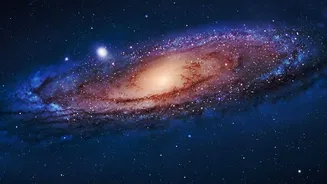
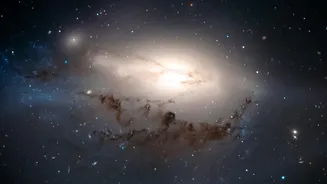
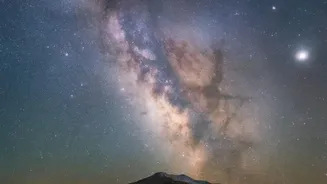
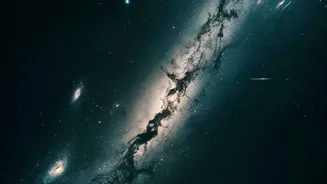
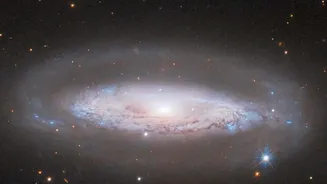
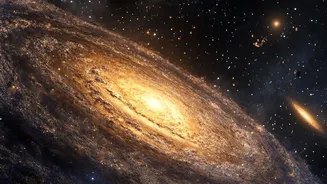
Imagine our entire galaxy, a sprawling disc of hundreds of billions of stars, performing a slow-motion somersault that took hundreds of millions of years to complete. This is the dramatic picture painted by new research from astronomers at Durham University.
According to their findings, presented at the Royal Astronomical Society's National Astronomy Meeting, the Milky Way's disc may have tilted by more than 90 degrees following a head-on collision with a smaller galaxy. This event, which would have fundamentally reoriented our place in the cosmos, is believed to have happened long before the Sun and Earth were even formed.
The Clue in the Halo
The evidence for this ancient upheaval doesn't come from a direct observation, but from solving a long-standing cosmic puzzle. Astronomers have been perplexed by the behavior of the Milky Way's 'stellar halo'—a sparse, spherical cloud of ancient stars that surrounds the main galactic disc. Data from the European Space Agency's (ESA) Gaia mission revealed that stars in the disc zip around the galactic center at about 220 kilometers per second. In contrast, the stars in the halo move incredibly slowly, at a mere fraction of that speed. This disparity didn't make sense, prompting scientists to wonder what could have braked the halo's rotation.
Cosmic Forensics and a Sausage
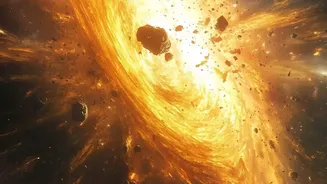
To find an answer, the research team turned to powerful supercomputer simulations. They modeled the evolution of galaxies similar to our own over billions of years. The simulations revealed a consistent pattern: galaxies with slowly rotating halos almost always had two things in common. They had experienced a massive, head-on merger with another galaxy, and their disc had subsequently flipped. This pointed to a prime suspect in the Milky Way's own history: a dwarf galaxy known as Gaia-Sausage-Enceladus. This smaller galaxy, so-named because of the sausage-like shape its scattered stars now form, slammed into a young Milky Way between 10 and 11 billion years ago in what is considered the most significant merger in our galaxy's history. The collision was so cataclysmic that it tore the smaller galaxy to shreds, but its gravitational influence was powerful enough to slowly torque the entire Milky Way disc into a new orientation.
Re-writing Our Galaxy's Story
This discovery doesn't just solve the mystery of the slow-moving halo; it adds a pivotal new chapter to the story of our galactic home. It suggests that the stable, orderly galaxy we inhabit today is the product of an incredibly violent and chaotic youth. If the disc did indeed flip, it means that most of the stars in the Milky Way—including, potentially, our own Sun—once traveled on vastly different paths than they do today. The collision with Gaia-Sausage-Enceladus profoundly reshaped our galaxy, scattering stars, likely triggering bursts of new star formation, and dominating the stellar halo we see now. This new understanding provides a crucial piece of context for how spiral galaxies like ours form, evolve, and settle after major cosmic accidents.