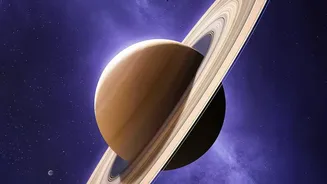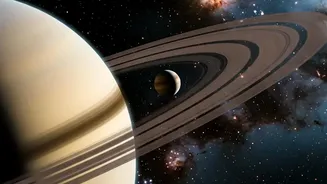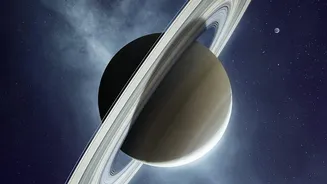






Saturn’s icy moon Enceladus is a top contender in the search for alien life, thanks to its hidden ocean. Now, fascinating new evidence for its habitability comes not from a space probe, but from sophisticated lab studies right here on Earth.
An Ocean World Far From Home
For years,
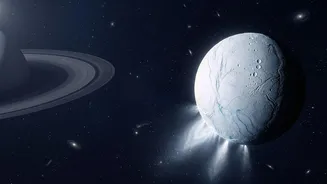
Enceladus has captivated scientists. Beneath a thick crust of ice, this small moon of Saturn hides a global ocean of liquid saltwater. What makes it truly special are the massive plumes of water vapor and ice grains that erupt from cracks in its surface, shooting hundreds of kilometres into space. These geysers offer a direct sample of the ocean below, and data from NASA's Cassini spacecraft, which flew through them, changed our understanding of this world. The plumes were found to contain salts, organic compounds, molecular hydrogen, and methane—strong evidence of hydrothermal activity on the seafloor where water interacts with a rocky core. On Earth, similar deep-sea hydrothermal vents, far from any sunlight, teem with life that thrives on chemical energy. This has made Enceladus one of the most promising places to look for life as we know it.
The Methane Mystery
One of the most tantalizing discoveries from Cassini was the presence of methane within the plumes. While methane can be produced by geological processes, on Earth it is overwhelmingly a byproduct of life. The conditions on Enceladus seemed right for a biological process called methanogenesis, where primitive microbes could theoretically consume hydrogen and carbon dioxide to produce energy and release methane. However, a significant hurdle remained. The data suggested Enceladus's ocean is highly alkaline, with a pH up to 11, which is as corrosive as some household cleaners. In such an alkaline environment, the amount of available carbon dioxide (CO2) would be extremely low, seemingly creating a major barrier for any potential life that might depend on it. This left a critical question: could any known life form actually survive, let alone thrive, in such an extreme environment?
An Alien Ocean in a Lab
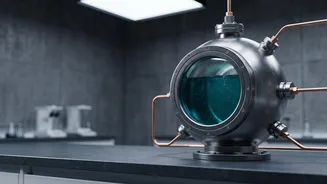
To answer this, a team of scientists led by researchers from Ludwig-Maximilians-Universität in Munich decided to create Enceladus in a bottle. In a laboratory, they painstakingly recreated the chemical conditions believed to exist on the moon's seafloor. They used a special oxygen-free chamber and mixed up a simulant containing carbonate salts and powdered minerals to replicate the alkaline, saltwater ocean and its rocky, chondrite-like core. Into this miniature alien ocean, they introduced a specific type of Earth microbe: Methanothermococcus okinawensis. This single-celled organism, a type of archaeon, lives near deep-sea hydrothermal vents on Earth and is known for producing methane by consuming hydrogen and CO2. The researchers wanted to see if this tough extremophile could handle the harsh conditions predicted for Enceladus.
Surprising Signs of Survival
The results were striking. While the microbe struggled to grow in a conventional lab medium at the high alkaline levels, it flourished in the Enceladus simulant. It not only survived the extreme pH of 11 but actively produced methane. The key was the simulation of water-rock interactions, which generated a steady supply of hydrogen gas, providing the energy source for the microbes. Even more impressively, the organism adapted its metabolism to scavenge the incredibly scarce amounts of available CO2, overcoming what was thought to be a critical barrier to life. The unique geochemistry of the simulated Enceladus environment actually helped the microbes survive. These findings do not prove life exists on Enceladus, but they demonstrate that a known biological process can function under its unique and challenging chemical conditions, broadening the known parameters for habitability.
What This Means for the Search for Life
This research significantly strengthens the case for Enceladus as a habitable world. It provides the first experimental evidence that microorganisms can overcome the severe carbon limitation imposed by its alkaline ocean. Combined with earlier findings that confirmed the presence of phosphorus—the last of the six essential elements for life (carbon, hydrogen, nitrogen, oxygen, phosphorus, and sulfur)—in Enceladus's ocean, the picture of a potentially life-sustaining environment becomes much clearer. The lab studies give scientists greater confidence that if life did emerge there, it could have a viable metabolic pathway to survive. This makes future missions to sample the plumes even more compelling, as we now have a better idea of what kinds of biosignatures to look for.