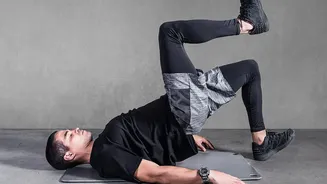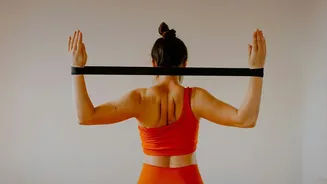








The Golden Rule: Technique First
Before you even think about increasing the intensity of your workout, the absolute priority must be proper form. Good technique is the difference between an exercise that builds you up and one that wears you down or leads to injury. When you perform a movement
correctly, you ensure that the target muscles are doing the work, which leads to the results you want. Poor form, on the other hand, places unnecessary stress on joints, ligaments, and tendons. Think of a squat: done well, it strengthens your legs and glutes. Done poorly, with knees caving in or your back rounding, it can strain your knees and spine. The goal of every repetition should be quality over quantity. Mastering the movement pattern first ensures that when you do add weight, you're strengthening muscles, not stressing vulnerable joints.
Understanding Progressive Overload
The principle behind getting stronger is called progressive overload. This simply means that to improve, you must continually challenge your muscles beyond their current capacity. Many people assume this just means lifting heavier weights. While increasing resistance is one way to do it, it's not the only way, especially in a home workout setting. You can also achieve progressive overload by adding more repetitions (reps), performing more sets, reducing rest time between sets, or slowing down the tempo of each exercise. A slow, controlled movement can be much more challenging and effective than a fast, jerky one using momentum. The key is to make the exercise harder in some small way over time, forcing your body to adapt and grow stronger.
Signs You Are Ready for More Resistance
How do you know when your technique is solid enough to handle more? Your body will give you clear signals. First, you should be able to complete all your planned reps and sets without your form breaking down on the last few. The movement should feel smooth and controlled from start to finish, not shaky or wobbly. You should also be able to feel the correct target muscle working. For example, during a bicep curl, you should feel the tension in your bicep, not strain in your lower back from swinging the weight. Another key indicator is the absence of pain. You should feel muscle fatigue or a 'burn', but never sharp, pinching, or joint pain. If you can check all these boxes, it might be time to increase the challenge.
How to Increase the Challenge Safely
Once you've earned the right to progress, do so gradually. A common guideline is to increase your load or volume by no more than 10 percent per week. If you are using resistance bands, you could move to the next level of tension. If using dumbbells, select the next available weight. Don't jump from 5kg to 10kg overnight. A safe progression might be to first increase your reps. If you can comfortably do 12 reps with good form, try for 15 on your next workout. Once you can hit 15 reps with perfect form, then you can consider increasing the weight and dropping back to 12 reps. This methodical approach ensures your muscles and connective tissues have time to adapt, significantly reducing your risk of injury and helping you bypass frustrating plateaus.
The Dangers of Rushing Your Progress
The 'no pain, no gain' mentality can be dangerous if misinterpreted. Pushing for more resistance before your body is ready is a fast track to injury, setting your progress back by weeks or even months. Common issues include muscle strains, tendonitis, and joint problems from repetitive stress with poor alignment. In extreme cases, pushing far beyond your body's capacity can lead to a serious condition called rhabdomyolysis, where damaged muscle fibres release proteins into the bloodstream that can harm the kidneys. Beyond physical harm, overtraining can also lead to decreased performance, persistent fatigue, and even a suppressed immune system. True, sustainable progress in fitness is a marathon, not a sprint.