




Why You Can't Just Talk
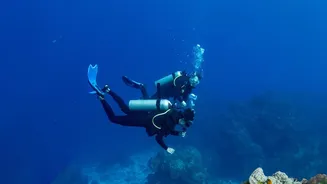
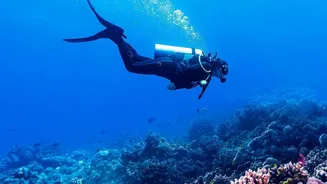
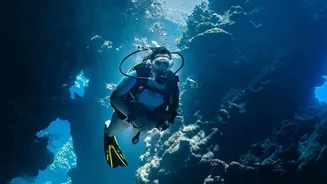
Once you're submerged, the regulator in your mouth makes speech impossible, and sound travels differently in water anyway. Your voice becomes a stream of bubbles. This is why a universal system of visual cues is one of the very first things you learn
in any open water certification course. This isn't just about convenience; it's the foundation of dive safety. Being able to clearly communicate with your dive buddy, guide, or instructor can be the difference between a minor inconvenience and a serious emergency. Every signal given requires an answer, ensuring that both divers are alert and understood.
The Most Important 'Word': OK
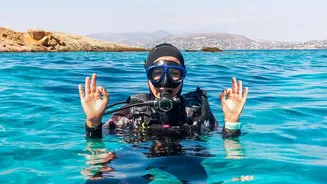
The most frequently used signal is 'OK'. Underwater, you form a circle with your thumb and index finger, keeping the other three fingers extended. This is both a question ('Are you OK?') and an answer ('I am OK'). You'll flash this sign to your buddy constantly throughout a dive, and they'll flash it back. It’s the primary way divers check on each other's well-being. On the surface, where this small gesture can be hard to see from a boat, the signal is different: you make a large circle by touching your fingertips to the top of your head.
Essential Safety and Directional Signals
Beyond 'OK', a core vocabulary of safety signals is non-negotiable. A flat hand, palm down, rocked back and forth like a seesaw means 'Problem' or 'Not OK'. You then point to the source of the issue, like your ear or mask. A thumbs-up signal doesn't mean 'good job'; it means 'End the dive' or 'Go Up'. Conversely, a thumbs-down means 'Go Down'. To signal to your buddy to level out at your depth, you'd give the 'Up' or 'Down' signal and then flatten your other hand horizontally above or below it. Since 2023, PADI courses also include a sign for 'I don't feel well', made by drawing a large oval with your fingers in front of your torso.
Talking About Your Air Supply
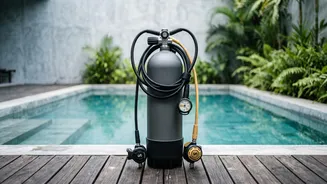
Your air supply is your lifeline, and communicating about it is critical. To ask your buddy how much air they have, you tap two fingers into the palm of your other hand. To respond, you use signals indicating the pressure. The most urgent air-related signals are 'Low on Air', indicated by making a fist and holding it to your chest, and the emergency signal 'Out of Air', which involves a slashing motion with a flat hand across your throat. Seeing this signal means your buddy needs to share air immediately.
Look Over Here!
Of course, not all communication is about safety. A huge part of the fun is sharing the experience. How do you tell your buddy to look at that incredible turtle or colourful nudibranch? You get their attention and then point. To signal 'Look', you point two fingers towards your own eyes. To indicate a specific creature, divers use a variety of signs. For example, placing a flat hand on your forehead signifies a Napoleon wrasse, while wiggling your fingers can represent a jellyfish. These are often learned regionally or from dive guides, adding a fun, local dialect to your underwater vocabulary.
Communicating in the Dark
When visibility is low or during a night dive, your dive torch becomes your primary communication tool. Instead of relying solely on hand signals, which are hard to see, you use the beam of light. A slow, large circle drawn with the light on the seafloor or a rock means 'OK'. A rapid side-to-side or up-and-down motion signals a problem or emergency, demanding immediate attention. To get your buddy's attention for something non-urgent, like pointing out nocturnal sea life, you can slowly wave the beam up and down. Alternatively, you can simply illuminate your hand and use the standard signals, being careful not to shine the bright light directly in your buddy's eyes.