



The Galaxy's Lingering Mystery
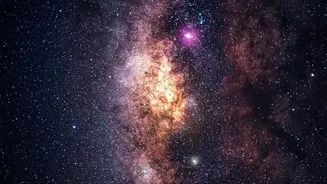
At the heart of our Milky Way galaxy, there is an excess of gamma-rays—the most energetic form of light in the universe. For years, scientists using instruments like NASA's Fermi Gamma-ray Space Telescope have observed this faint, diffuse glow but have struggled
to pinpoint its exact source. After accounting for all known gamma-ray producers, such as black holes and pulsars, a significant surplus remains. This cosmic puzzle, known as the Galactic Center Excess (GCE), has led to several competing theories, from a population of undiscovered spinning stars to the exciting, yet unproven, idea of dark matter particles annihilating each other.
Cosmic Suspects: Neutron Stars
Enter the neutron star. These are not stars in the conventional sense but are the ultra-dense collapsed cores left behind after a massive star goes supernova. Imagine something slightly more massive than our sun crushed into a sphere the size of a city. A single teaspoon of neutron star material would weigh a billion tonnes. Sometimes, two of these incredible objects are locked in a gravitational dance, orbiting each other in a binary system. As they spiral closer together over millions of years, they are destined for a cataclysmic collision that unleashes an almost unimaginable amount of energy.
A 'Kilonova' Explanation
This cosmic smash-up is known as a kilonova. It's an event so powerful it sends ripples through spacetime as gravitational waves and produces a brilliant flash of light. According to a recent, yet-to-be-peer-reviewed study, such an event could be the culprit behind the mysterious glow. The new hypothesis specifically points to an unusual gamma-ray source known as HESS J1507−622, which was detected years ago but had no obvious counterpart at other light wavelengths like X-rays or radio waves. Researchers propose that the debris from a long-ago kilonova could be producing the gamma-rays we see today. This collision would have been a cosmic forge, creating and spewing out heavy elements like gold, platinum, and uranium into the galaxy.
Connecting the Dots in the Dark
The new model suggests that a neutron star merger that occurred less than 1,000 years ago could explain the observed properties of the HESS J1507−622 source. The researchers argue that the 'kilonova remnant' scenario consistently accounts for the gamma-ray signal's characteristics where other theories fall short. One intriguing part of the puzzle is why such an event, which may have been visible to the naked eye, was not recorded in historical texts. The study suggests the event's location, far in the southern sky, would have made it difficult to observe for ancient astronomers in China, Europe, and other northern regions who kept meticulous records.
A Preliminary but Compelling Idea
It is crucial to remember that this is a preliminary study and the hypothesis has not yet been peer-reviewed. The 'dark matter annihilation' theory, for instance, remains a viable contender for explaining the broader gamma-ray excess at the galactic center. However, the kilonova hypothesis provides a fascinating alternative rooted in known astrophysical events rather than the exotic physics of dark matter. If confirmed, this would not only solve a long-standing mystery but also mark the first time a kilonova remnant has been identified within our own Milky Way galaxy. It would offer a tangible link between the cosmic 'gold factories' of neutron star mergers and a persistent glow in our sky, reminding us that the universe is never fully figured out.