






The Roaring Heart of Onam
Pulikali, which translates to ‘play of the tigers’, is a 200-year-old folk art form from Kerala, celebrated with immense vigour on the fourth day of Onam. At its core, it is a spectacle of street theatre where performers, or ‘Pulikalikkar’, painted as
tigers and leopards, dance to the powerful rhythms of percussion instruments like the chenda and thakil. Traditionally centered in Thrissur, this performance art revolves around the theme of a tiger hunt, with performers mimicking the powerful, stealthy movements of the big cats. While the energetic dance and festive atmosphere are what draw thousands of spectators, the true artistry begins hours before the first drumbeat, in a quiet, meticulous process of transformation.
The Canvas Comes to Life
The argument for Pulikali as visual art starts with the body painting. This is not a hasty costume change; it's a monumental act of creation. Long before dawn, performers prepare their bodies, which are first shaved to create a smooth surface. Then, for the next five to seven hours, they sit patiently as skilled artists apply layers of vibrant paint. Traditionally, this was a mixture of tempera powder and varnish, but many troupes now use more skin-friendly emulsions. The artists don't just paint stripes; they use the human form—the curve of the stomach, the muscles of the back—to create a three-dimensional, living sculpture of a tiger. Each stripe and spot is carefully placed to enhance the illusion of a prowling feline, turning a person into a breathing work of art.
A Symphony of Stripe and Symbol
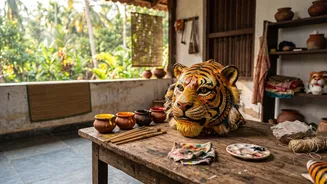
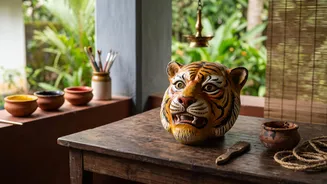
The visual language of Pulikali is incredibly detailed. The designs vary, representing different types of big cats, from the striped tiger (Varayan Puli) to the spotted leopard (Pulli Puli). The colours themselves are symbolic, with bold yellows, oranges, and blacks dominating the scene. The most captivating feature is often the face painted onto the performer's belly, which comes alive as they dance, its expression changing with every shake and roll. In the early days, faces were also painted, but today, performers often use elaborate masks, complete with tongues and teeth, adding another layer to the visual spectacle. This entire ensemble—the detailed body art, the expressive masks, and the jingling belts—is a curated artistic statement, not merely a costume.
Performance as a Moving Gallery
If the body is the canvas, then the dance is the exhibition. The movements in Pulikali are specifically designed to showcase the art. The signature belly-shaking is not just a dance step; it’s a way to animate the painted face, making it snarl or smile. The pouncing, stalking, and playful leaps bring the tiger stripes to life, creating a dynamic visual experience where the art is in constant motion. The procession through the streets of Thrissur acts as a moving gallery, allowing the public to witness these living artworks from all angles. The performance doesn't just complement the visual art; it is essential for its full expression. The dance gives the painting its roar.
The Enduring Roar of Tradition
Introduced by Maharaja Rama Varma Sakthan Thampuran of Cochin to celebrate Onam with a display of bold, masculine energy, Pulikali has evolved into a cherished community event. It has become a symbol of Thrissur's cultural identity. In recent years, the tradition has adapted, with the inclusion of female performers, or 'Pulimadas', since 2016, breaking a long-standing gender barrier. This evolution shows that while the core artistic principles remain, Pulikali is not a static relic. It is a living, breathing art form that continues to capture the imagination, proving that it is a profound synthesis of visual artistry and performance.