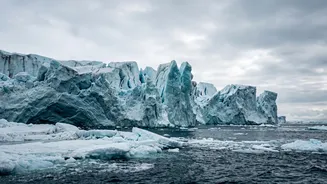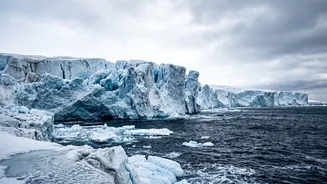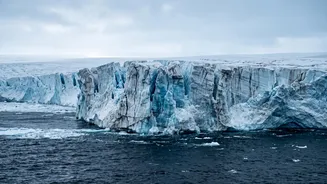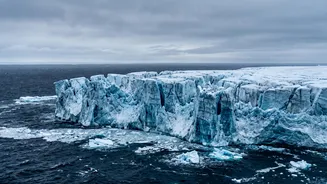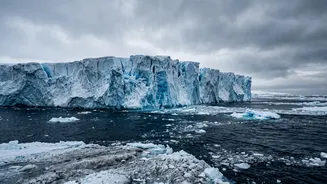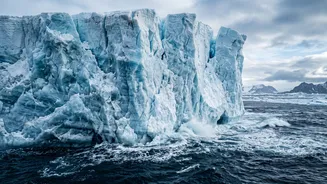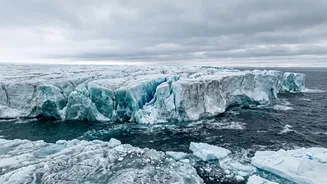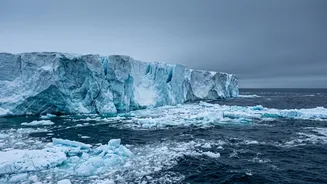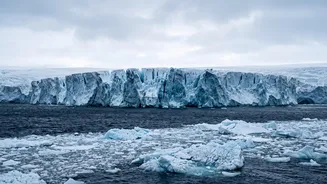



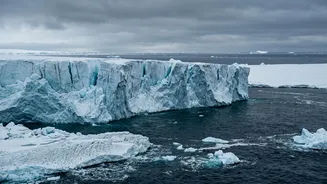
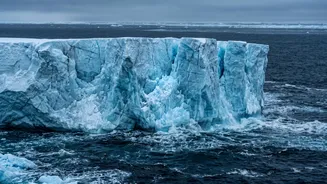
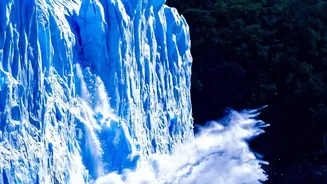
In West Antarctica sits a river of ice so vast and unstable it has been nicknamed the 'Doomsday Glacier'. This isn't just hyperbole; its future is one of the biggest questions facing climate scientists and coastal communities across the globe.
An Ice Giant on Unstable Ground
Thwaites
Glacier is colossal, covering an area roughly the size of Great Britain. It currently contributes about 4% of all global sea-level rise, a figure that has scientists watching its every move. If the entire glacier were to collapse into the ocean, it holds enough ice to raise sea levels by over two feet (65 cm). More alarmingly, it acts like a cork, holding back the rest of the West Antarctic Ice Sheet. Its failure could eventually trigger a wider collapse, leading to a sea-level rise of around 10 feet, which would redraw coastlines worldwide and threaten cities from Mumbai to Miami.
The Enemy Within: Warm Ocean Water
The primary threat to Thwaites isn't from above, but from below. The glacier rests on bedrock that is mostly below sea level and slopes downward inland. This unique topography allows relatively warm ocean water to push its way underneath the ice. This isn't boiling water, but at one or two degrees above freezing, it's warm enough to cause vigorous melting at the glacier's base, particularly at what is called the 'grounding line'—the crucial point where the ice leaves the seabed and begins to float. As this grounding line retreats, more of the glacier's underbelly is exposed to the melting power of the ocean, creating a dangerous feedback loop.
Why Predictions Are So Difficult
The central problem highlighted by the headline is uncertainty. For years, computer models struggled to accurately recreate the glacier's retreat that has already been observed, making future predictions unreliable. Recent research from late 2026 has revealed why older models may have been too conservative. Scientists now understand there isn't a neat, thin grounding line, but a wider 'grounding zone' several kilometres across. Tides are actively pumping warm seawater into this zone, weakening the glacier's connection to the seabed far more aggressively than previously thought. New models incorporating this messy reality suggest Thwaites' contribution to sea-level rise by 2100 could be double earlier estimates, even without further global warming.
A Committed Loss
The news gets more complex. One recent study found that even if ocean melting were to stop completely—an impossible scenario—Thwaites is already committed to losing ice for at least the next 150 years due to past melting. The glacier appears to have been pushed into a state of unavoidable retreat. This doesn't mean a sudden, catastrophic collapse is imminent this century. Some of the most extreme 'ice cliff collapse' scenarios are now considered less likely by 2100. However, the glacier's retreat is locked in, and will be made worse by ongoing greenhouse gas emissions. The key uncertainty is no longer if it will have a major impact, but how fast that impact will arrive.
Global Stakes and Local Concerns
For India, with its 7,500km coastline and densely populated coastal cities like Kolkata and Mumbai, the fate of a faraway glacier is a direct concern. A two foot rise from Thwaites alone would be devastating, but the potential ten foot rise from a wider West Antarctic collapse would be an existential threat to low lying regions globally. The uncertainty in the forecasts from Thwaites makes planning for this future incredibly challenging for governments and communities. The 'when' and 'how much' are billion dollar questions that scientists in the International Thwaites Glacier Collaboration are racing to answer.