






Meet the 'Erprober'
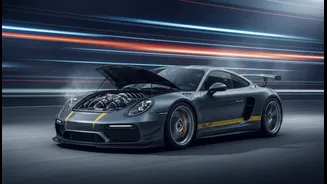
The car making waves at the 2026 Goodwood Festival of Speed is not a polished, production-ready supercar. It’s called the B8 Erprober, which translates from German to “Tester.” This vehicle is a development mule, a rolling laboratory designed for one
purpose: to validate the extreme technologies that will power the next generation of Ruf automobiles. At its core, the Erprober is a heavily modified Ruf CTR3, a car that already features a bespoke chassis. For this project, engineers stretched the frame by nearly four inches to accommodate its radical new powertrain. The car's livery, designed by Aloisa Ruf, pays homage to the iconic 1987 CTR 'Yellowbird' with its Blossom Yellow accents, while flowing figure-eight graphics hint at the revolutionary engine hiding within.
A Radical New Heart: The Flat-Eight
For decades, Ruf built its legendary reputation on mastering the flat-six engine. The B8 Erprober signals a monumental shift. The main event is its namesake: the B8, an all-new 4.8-liter, twin-turbocharged flat-eight engine. Designed and built entirely in-house, this 'boxer' engine produces over 1,000 horsepower and 738 lb-ft of torque without any hybrid assistance. This is pure internal combustion engineering at its most ambitious. What makes this so significant is that the flat-eight layout is incredibly rare in road cars, having been used almost exclusively in purpose-built Porsche race cars in the 1960s. By developing a modern version for a future production model, Ruf is venturing into uncharted territory.
An Uncompromising Vision
In an era where dual-clutch automatics and hybrid systems dominate the hypercar landscape, Ruf is doubling down on driver engagement. The B8's monstrous 1,000-horsepower engine is paired with a six-speed manual transmission, also developed in-house. This combination of a brand-new, high-revving flat-eight engine and a traditional manual gearbox is a bold statement. It underscores Ruf's philosophy of building cars that deliver a raw, unfiltered connection between the driver, the machine, and the road. This project isn't about chasing the absolute fastest lap times; it’s about perfecting a thrilling and durable driving experience, a hallmark the brand has cultivated since it began tuning Porsches in the 1960s.
More Than a Tuner, a Manufacturer
While Ruf's history began with modifying Porsches, the company has long been recognized as a full-fledged manufacturer by the German government, issuing its own vehicle identification numbers (VINs). Models like the 2007 CTR3 and 2017 CTR Anniversary were built on bespoke chassis, moving the company far beyond its tuning roots. The B8 Erprober and its in-house engine and transmission represent the next logical step in this evolution. It solidifies Ruf's capability as a low-volume, high-end manufacturer that can create unique vehicles from the ground up, not just enhance existing ones. This project is a multi-million-dollar investment in the company's independence and technical prowess.
What the Erprober Means for Ruf's Future
The B8 Erprober itself is not for sale; it is a crucial stepping stone. Ruf has confirmed that the B8 flat-eight engine is destined for a future production model, though details remain scarce. This move could allow Ruf to create a new flagship hypercar, distinct from its beloved 911-inspired models. Company owner Alois Ruf described the moment as one that will “define the future.” By demonstrating the car publicly at Goodwood with driver Tanner Foust behind the wheel, Ruf is using its development process as a statement of intent. The Erprober is a clear signal that after more than 80 years, the small German firm is not just resting on its laurels but is engineering its next legendary chapter.