






A Celestial Show for the Social Feed
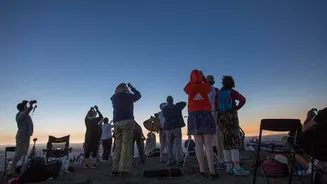
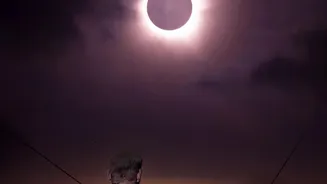
For a generation fluent in digital culture, an eclipse is a must-see astronomical event. The build-up is palpable online, with astronomy groups sharing viewing times, safety tips for using special glasses, and links to NASA’s live feed. When the moon
begins to obscure the sun, or the Earth’s shadow falls upon the moon, social media timelines are flooded with images—from professional-looking shots taken with telephoto lenses to simple pinhole camera projections. It’s a collective, global experience, a moment of scientific wonder where people gather online and on rooftops to witness the clockwork of the cosmos. This modern approach treats the eclipse not as an omen, but as a spectacular, predictable, and beautiful natural phenomenon. It’s an opportunity to feel connected to the universe and share that awe with thousands of others online.
The Myth of the Cosmic Serpent
Contrast this with the silence in homes where age-old traditions hold sway. According to Hindu mythology, eclipses, or 'Grahan', are deeply inauspicious. The most popular legend comes from the Samudra Manthan, or the churning of the cosmic ocean. In this story, the demon Svarbhanu disguised himself to steal a sip of Amrit, the nectar of immortality meant for the gods. The Sun (Surya) and Moon (Chandra) gods spotted the imposter and alerted Lord Vishnu, who swiftly beheaded the demon with his Sudarshana Chakra. But because the nectar had already touched his lips, the demon's head and body became immortal. The head, known as Rahu, and the body, Ketu, were cast into the sky as shadow planets. Filled with vengeance, Rahu is said to periodically swallow the sun or moon, causing an eclipse. Since he has no body, the celestial orb eventually re-emerges, but the act of being swallowed is seen as a moment of cosmic distress.
Rituals of Precaution and Purity
This mythological understanding gives rise to a host of protective rituals. The core belief is that during a Grahan, the atmosphere becomes impure and emits negative energies. To avoid this, many people stay indoors and close their curtains. Fasting is widely practiced, as it's believed that food cooked or consumed during the eclipse can become contaminated. Leftover food and water are often protected by placing Tulsi (holy basil) leaves in them, which are thought to have purifying properties. Activities involving sharp objects, like chopping or sewing, are also avoided. After the eclipse passes, a ritual bath is common to cleanse oneself of any negative residue, and temples, which often close during the event, perform purification rites.
A Special Warning for Mothers-to-Be
Pregnant women are given the most stringent warnings during an eclipse. Tradition dictates they must take extra precautions to protect their unborn child from supposed harmful energies that could lead to birth defects. They are advised to stay indoors, lie straight, and often chant prayers or mantras. This particular belief remains one of the most persistent, passed down through generations and observed even in households that might be otherwise modern in their outlook. While there is no scientific evidence to support this or any other health risks from eclipses (other than the obvious danger of looking at a solar eclipse without protection), the cultural hold of these traditions remains powerful.
Navigating Two Worlds in One Home
The dichotomy of eclipse day perfectly illustrates the unique fabric of modern India. It's a country where scientific advancement and ancient faith coexist, often within the same family. It's not uncommon for a younger family member to be setting up a telescope on the balcony while their grandparents are observing a fast in the prayer room. The internet celebrates the event as a testament to astronomical precision, while tradition views it as a time for spiritual introspection and caution. This isn't necessarily a conflict, but rather a reflection of a society in transition. Many people find a way to bridge both worlds—perhaps watching a live stream of the 'blood moon' and then taking a bath afterward to respect the wishes of their elders. Ultimately, the eclipse holds up a mirror to a culture that has mastered the art of looking forward without letting go of its past.