




The Promise of a Traffic-Free Commute
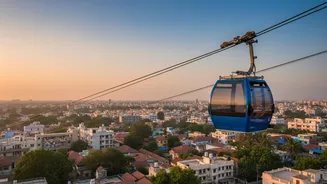
In cities choked by traffic, the idea of floating over the gridlock in a gondola is incredibly appealing. India is betting big on this vision with its National Ropeways Development Programme, 'Parvatmala Pariyojana'. The flagship project, and the country's
first true urban ropeway, is taking shape in Varanasi. Set to connect the city’s main railway station to the bustling Godowlia Chowk, it promises to slash a chaotic 45-to-60-minute road journey to a predictable 16 minutes. With nearly 150 cabins, each holding 10 passengers, the system is designed to transport thousands of people every hour. This isn't just for tourism; it's being presented as a genuine solution for daily commuters, a new artery for the city's heart. For residents and the millions of pilgrims who visit, it sounds like a game-changer, offering a fast, efficient, and environmentally cleaner alternative to navigating the city's famously narrow and congested streets.
The Bottleneck on the Ground
The core promise of the ropeway is speed. But that speed is measured from the moment you board a cabin to the moment you alight. It doesn’t account for the total journey time, which includes getting to the station, buying a ticket, and, most crucially, waiting in a queue. This is where the headline promise could unravel. A ropeway is a continuous-loop system, but its capacity is finite. The Varanasi system, for example, is designed for a throughput of about 3,000 passengers per hour in each direction. While that sounds like a lot, peak demand during festivals or even daily rush hour could easily exceed this, leading to queues that stretch outside the station doors. As experts on pilgrimage infrastructure have warned, if a system's capacity is miscalculated, it doesn't solve a crowding problem; it simply moves it from the trekking path to the ropeway queue. The entire time-saving advantage of a 16-minute ride could be nullified by a 45-minute wait just to get on board.
It’s a Throughput Game
The success of an urban ropeway isn't just about the speed of its cables; it’s about the efficiency of its stations. Planners call this 'throughput'—the actual rate at which people can move through the entire system. This is influenced by dozens of small details: the speed of ticketing (whether physical or digital), the width of corridors, the number of turnstiles, and the clarity of signage. Even the time a cabin 'dwells' at the platform for boarding and alighting is a critical variable. An efficient station unloads and loads passengers seamlessly, keeping the gondolas moving and the lines short. An inefficient one creates friction at every step, causing passenger flow to back up. Analysis of the terminal station in Varanasi has already flagged the potential for it to add to local congestion, not just solve it, by concentrating thousands of arrivals in an already crowded junction. The design of the waiting area itself becomes paramount, especially for systems expecting heavy use.
Lessons in Managing the Flow
India is not the first country to use gondolas for urban transit. Cities in South America, like Medellín in Colombia and La Paz in Bolivia, have pioneered this technology for years. Their success offers valuable lessons. A key strategy has been deep integration with the wider public transport network. In Medellín, a single transport card allows for seamless transfers between the ropeway, metro trains, and buses, which helps distribute passenger arrivals and departures more evenly. Effective crowd management is also vital. This includes dedicated staff to ensure cabins are filled to capacity during peak times and clear systems to manage queues for different destinations or for passengers with special needs, like the elderly or those with disabilities. These systems don't just see themselves as isolated lines but as integral parts of a city-wide mobility plan, a perspective that will be crucial for India's upcoming projects, such as the planned ropeway connecting Dehradun and Mussoorie.