





A Moon Bigger Than a Planet
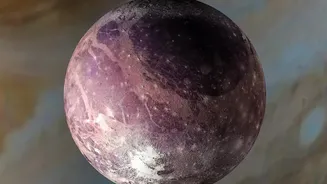
Let's get the main talking point out of the way: Ganymede is enormous. With a diameter of about 5,268 kilometres, it is larger than the planet Mercury and the dwarf planet Pluto. If it were orbiting the Sun instead of Jupiter, it would almost certainly
be classified as a planet. Discovered by Galileo Galilei in 1610, it is one of the four large 'Galilean' moons, but its sheer scale sets it apart. However, its size, as impressive as it is, is merely the opening chapter in the story of this complex and captivating world.
The Solar System's Only Magnetic Moon
Perhaps Ganymede's most remarkable feature is that it is the only moon in the solar system known to generate its own magnetic field. Discovered by NASA's Galileo spacecraft in 1996, this magnetosphere carves out its own protective bubble within Jupiter's much larger, more powerful magnetic field. This is a trait typically reserved for active planets like Earth. The field is believed to be generated by a churning, liquid iron core, much like our own planet's. This internal dynamo not only creates beautiful auroras at Ganymede's poles but also points to a geologically active and differentiated interior—a complex world with a hot, dynamic heart.
A Vast, Hidden Ocean
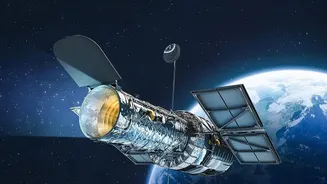
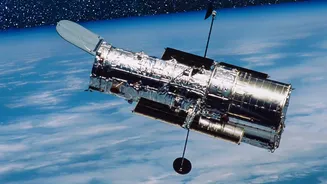
Beneath a thick crust of ice, scientists have found compelling evidence for a massive saltwater ocean. Observations from the Hubble Space Telescope, which studied the rocking motion of Ganymede's auroras, suggest this ocean could be up to 100 kilometres deep. It is estimated to contain more water than all of Earth's oceans combined. The presence of liquid water is a critical ingredient in the search for life, making Ganymede a primary target for astrobiologists. Some models even suggest a unique 'club sandwich' structure, with layers of ice and liquid water stacked on top of one another, creating distinct environments under immense pressure.
A World of Contrasting Terrains
Ganymede's surface tells a tale of two distinct geological eras. Roughly one-third of the surface is dark, ancient, and heavily pockmarked with craters, some dating back billions of years. The other two-thirds consist of brighter, younger terrain marked by an intricate system of long, parallel ridges and troughs known as 'grooved terrain'. This complex network of grooves is thought to be the result of tectonic activity, where the moon's icy crust was stretched and fractured, possibly due to internal heating and upwelling. This geological dichotomy suggests a long and violent history of both external bombardment and internal transformation.
A Prime Target for Future Exploration
Because of these tantalizing features, Ganymede is a star destination for planetary science. The European Space Agency's (ESA) JUICE mission (JUpiter ICy moons Explorer) is currently en route to the Jovian system, with Ganymede as its primary scientific target. In 2034, JUICE is set to become the first spacecraft ever to orbit a moon other than our own. The mission will study Ganymede's ocean, magnetic field, and icy shell in unprecedented detail, aiming to understand its potential for harbouring life. By studying Ganymede, scientists hope to gain crucial insights into how icy worlds form and evolve, and what conditions might make a world habitable.