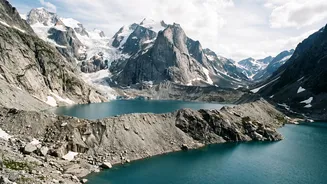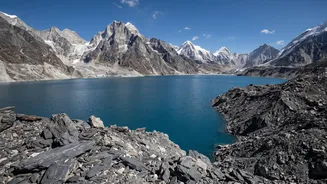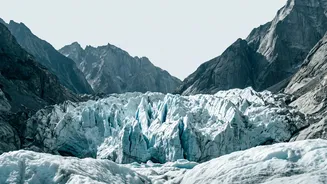




The majestic Himalayas, a source of life-giving rivers for millions, hold a growing danger. High among the peaks, melting glaciers are forming unstable lakes—ticking time bombs that can unleash devastating floods with little to no warning.
A 'Water Bomb' in the Mountains
A Glacial Lake
Outburst Flood, or GLOF, is one of nature's most sudden and destructive events. Imagine a massive natural reservoir, filled with millions of cubic metres of glacial meltwater, perched precariously at high altitudes. These lakes are often dammed by unstable walls of moraine—loose rock, sediment, and ice left behind by a retreating glacier. When this natural dam fails, it releases a torrent of water, mud, and boulders that scours entire valleys. The trigger can be anything from a landslide or avalanche crashing into the lake to the simple pressure of too much water. The resulting flood wave can travel hundreds of kilometres, destroying everything in its path: homes, roads, bridges, and critical infrastructure like hydropower dams.
The Climate Change Connection
The threat of GLOFs is being amplified by climate change. The Hindu Kush Himalaya region is warming at a rate faster than the global average, accelerating glacier melt. This has led to a dramatic increase in both the number and size of glacial lakes across the region. Since the 1990s, Himalayan glacial lakes have tripled in number and area. States like Sikkim, Himachal Pradesh, Uttarakhand, and Arunachal Pradesh are on the front lines. Scientists warn that GLOF risks are predicted to peak around 2050 as glaciers continue to retreat, creating new, potentially more dangerous lakes at higher, steeper elevations. This isn't a distant threat; it's a clear and present danger unfolding in India's backyard.
The Devastating Human Cost
The human and economic toll of GLOFs is staggering. The October 2023 disaster at South Lhonak Lake in Sikkim is a stark reminder. A sudden outburst sent a flood wave down the Teesta River, leading to dozens of deaths, thousands displaced, and the obliteration of the Chungthang dam, a major hydropower project. The damage and losses were estimated at over Rs 1,480 crore. Tragically, this is not an isolated incident. A UN-led study found that while India ranks third in the number of GLOF events in the Himalayan region, it has the highest number of reported deaths, with over 6,000 fatalities between 1835 and 2025. These events not only claim lives but also wash away livelihoods, isolate communities, and set back development by decades.
The Race for a Solution
In the face of this escalating hazard, the focus has turned to technology and preparedness. Early Warning Systems (EWS) are seen as a critical tool to save lives. These systems involve installing automatic sensors at high-risk lakes to monitor water levels, pressure, and seismic activity. When a dangerous threshold is crossed, an alert is automatically transmitted downstream. This provides precious time—minutes or hours—for communities to evacuate. India's National Disaster Management Authority (NDMA) has issued guidelines for GLOF management and is overseeing the National GLOF Risk Mitigation Programme to assess and monitor high-risk lakes across the Himalayas. International collaboration, including support from Switzerland, has been instrumental in piloting these technologies in states like Sikkim.
Challenges on the Ground
Implementing effective warning systems in the Himalayas is a monumental challenge. The lakes are located in some of the most remote and inaccessible terrain on Earth, making the installation and maintenance of equipment difficult and expensive. Furthermore, a sensor is only one part of the solution. The warning must reach the last person in the most remote village. This requires robust, multi-' channel communication networks—using everything from sirens and satellite phones to SMS alerts and local volunteers—and extensive community training and awareness drills. The transboundary nature of Himalayan rivers adds another layer of complexity; a GLOF in Bhutan or Nepal can cause catastrophic flooding downstream in India, necessitating strong cross-' border cooperation on data sharing and disaster response.