




The Sun’s Great Temperature Mystery
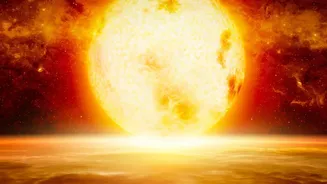
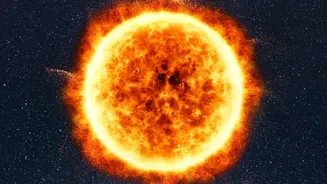
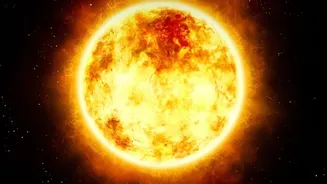
Imagine standing by a bonfire and feeling more heat the further you walk away. It doesn’t make sense, yet that’s precisely what happens on the Sun. Its visible surface, the photosphere, simmers at a relatively cool 5,500 degrees Celsius. But high above
it, the Sun's atmosphere, or corona, sizzles at a staggering one to two million degrees, and sometimes even higher. This phenomenon, known as the coronal heating problem, has puzzled astrophysicists since it was first identified nearly a century ago. The laws of thermodynamics suggest heat should flow from hot to cold, meaning the corona should be cooler than the surface, not hotter. For decades, scientists have hunted for the hidden mechanism that is pumping incredible amounts of energy up into the corona, effectively superheating it against all expectations.
Enter the Magnetic Engine
The leading consensus is that the Sun's powerful and complex magnetic field is the key. The Sun isn't a solid ball; it's a turbulent sphere of superheated plasma—electrically charged gas—that generates immense magnetic fields. These magnetic field lines are rooted deep within the Sun's convective zone but loop and stretch far out into the corona. The turbulent, boiling motion on the Sun's surface constantly twists, stretches, and shakes these magnetic field lines. Scientists have long theorised that this magnetic activity somehow transfers the Sun’s internal energy upward, but the exact process has remained elusive. The two main theories involve either a constant barrage of tiny explosions called 'nanoflares' or the propagation of powerful magnetic waves.
Riding the Alfvén Waves
A prime suspect in this mystery is a specific type of magnetic wave called an Alfvén wave. First theorised in 1942 by Hannes Alfvén, who later won a Nobel Prize for his work, these waves are vibrations that travel along magnetic field lines, much like a wave traveling down a plucked guitar string. The idea is that the churning motions on the solar surface generate these waves, which then travel up into the corona, carrying huge amounts of energy with them. Once in the thin atmosphere of the corona, these waves 'crash' or dissipate, converting their motion into heat. Recent observations from powerful solar telescopes have confirmed that these waves not only exist but carry enough energy to potentially heat the corona.
The Breakthrough in the Turbulence
The latest piece of the puzzle comes from studying the dark, cooler patches on the Sun's surface known as sunspots. These are areas of incredibly intense magnetic activity. Using advanced telescopes, scientists have recently observed swirling, turbulent vortices of plasma within these sunspot regions. New research indicates that the collision and interaction of outward-moving and reflected Alfvén waves within the solar atmosphere creates this turbulence, which in turn generates heat. A recent study published in The Astrophysical Journal used a laboratory experiment to mimic the conditions in the solar atmosphere and demonstrated for the first time that this process of wave reflection and subsequent turbulence can indeed heat plasma. This provides direct, tangible evidence supporting the long-held theory.
A Clue, Not Yet a Conclusion
While the link between sunspot turbulence and Alfvén wave heating is a major step forward, it doesn't mean the case is closed. Solar physics is incredibly complex, and it is likely that several mechanisms are at play. Some scientists believe that a combination of processes, including both Alfvén waves and nanoflares, contributes to the overall heating. However, the ability to now directly observe the effects of this turbulence provides a crucial new data point. It gives researchers a specific process to look for with powerful instruments like NASA's Parker Solar Probe, which is flying through the corona itself. Understanding how Alfvén waves dissipate their energy into heat remains a key focus of ongoing research. Each new observation brings us one step closer to finally solving one of the greatest mysteries about our closest star.