






Deconstructing the Advanced Move
In a video shared by her fitness coach, Kriti Sanon is seen hanging from an overhead bar and performing rapid flutter kicks against a large stability ball held in front of her. Labelled a “hanging core challenge,” this exercise is an advanced variation
that targets multiple muscle groups simultaneously. It demands significant grip strength to support the body, shoulder stability to prevent swaying, and powerful core engagement to control the torso while the legs move. The hip flexors are also heavily involved in driving the kicking motion. Experts note that the real challenge isn't just kicking the ball but doing so while maintaining complete control and preventing the body from swinging with momentum. This level of control is what makes it an expert-level exercise.
The Trainer's Crucial Role
It’s important to note that Kriti is not performing this exercise alone. Her trainer is present, not only positioning the ball but also providing support around her waist. This professional supervision is non-negotiable for a move of this complexity. A trainer ensures proper form, preventing the client from relying on momentum, which can lead to injury. They provide spotting for safety, offer immediate feedback on technique, and help stabilize the body, allowing the target muscles to be isolated effectively. Attempting such a demanding hanging exercise without adequate strength or expert guidance significantly increases the risk of shoulder strain, back injury, or a fall.
Why Use a Stability Ball?
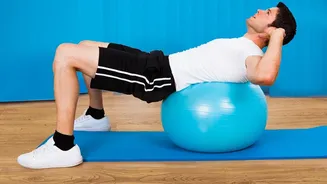
A stability ball, also known as a Swiss ball or exercise ball, is a versatile tool designed to challenge your balance and core. Its unstable surface forces your deep core muscles, including abdominals and lower back muscles, to work harder to maintain control. Studies have shown that performing exercises on an unstable surface can activate the core up to 30% more than doing the same move on a stable floor. This enhanced muscle activation helps improve posture, coordination, and overall stability, which can reduce the risk of injury in other activities. Even without attempting Kriti's advanced move, incorporating a stability ball into your routine is a proven way to build a stronger, more functional core.
For Beginners: Build Your Foundation
Before you even think about hanging from a bar, it's essential to build a solid foundation. You can use the stability ball to master the basics of core control. Start with a Stability Ball Plank. Place your forearms on the ball with your legs extended behind you, keeping your body in a straight line from head to heels. Hold for 20-30 seconds, focusing on keeping your core tight. Another great starting point is the Wall Squat. Stand with the ball between your lower back and a wall, feet shoulder-width apart. Lower yourself into a squat, letting the ball roll up your back. This helps with form and stability.
For Intermediates: Progressing Safely
Once you feel comfortable with the basics, you can move on to more dynamic exercises. The Stability Ball Knee Tuck is an excellent progression. Start in a high-plank position with your shins resting on the ball. Engaging your core, pull your knees in toward your chest, rolling the ball forward. Pause, then slowly extend your legs back to the starting position. Another effective move is the Stability Ball Hamstring Curl. Lie on your back with your heels and calves on the ball. Lift your hips into a bridge, then bend your knees to pull the ball toward you. These exercises build the specific core and hamstring strength needed for more advanced movements.
General Safety for Home Workouts
Working out with a stability ball at home requires a few safety precautions. First, ensure you have the correct size ball; when seated, your knees should be at a 90-degree angle. Always inspect the ball for any damage or punctures before use. Make sure your workout area is clear of sharp objects or furniture. When trying a new exercise, perform the movements slowly and with control, focusing on form rather than speed. If you feel unstable, use a wall or sturdy chair for support. It’s also wise to avoid using heavy weights with a stability ball unless you are highly experienced and have a spotter present.