




The Far Side's Communication Problem
Since the Apollo era, missions to the Moon have relied on a direct line of sight to Earth for communication. This has been a fundamental constraint on lunar exploration. Whenever a spacecraft or astronaut travels to the far side of the Moon, the entire
3,500-kilometre-wide body of rock blocks all radio signals, creating a communications blackout. This limitation effectively made landings on the far side too risky for early human missions and has restricted surface operations to areas with a clear view of home. For the ambitious Artemis program, which aims to establish a sustained human presence on the Moon—particularly around the resource-rich South Pole—this intermittent connectivity is no longer viable. To build a permanent base, conduct complex science, and ensure astronaut safety, continuous, reliable communication is not a luxury; it's a necessity.
Building the 'Internet' for the Moon
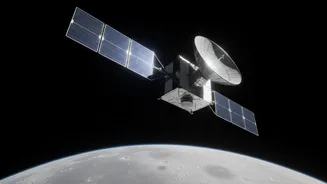
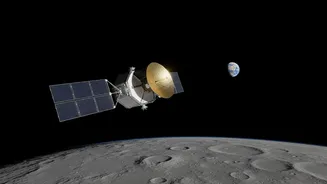
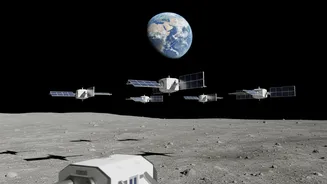
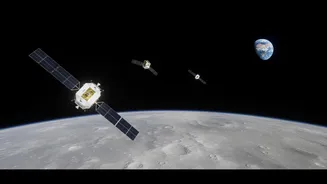
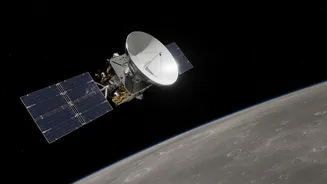
NASA's solution is the Lunar Communications Relay and Navigation Systems (LCRNS) project, a plan to place a network of satellites in orbit around the Moon. This initiative is a core component of a broader architecture called LunaNet, which aims to create an internet-like service for the Moon. Instead of missions communicating directly with Earth, they will connect to these orbiting relays, which will then beam the data back home. This model is similar to how the Tracking and Data Relay Satellites (TDRS) constellation has provided continuous communication for the International Space Station and the Hubble Space Telescope in Earth orbit for decades. By partnering with commercial companies to build and operate this infrastructure, NASA is fostering a new lunar economy while ensuring its missions have the support they need. The plan involves a phased rollout, with an initial capability expected to be in place between 2025 and 2028.
More Than Just Talk: GPS for the Moon
The LunaNet architecture will provide much more than just a communications link. These relay satellites are designed to offer a suite of services, critically including Position, Navigation, and Timing (PNT). In essence, they will act as a GPS constellation for the Moon. This will allow astronauts and robotic rovers to navigate the lunar surface with unprecedented precision, independent of Earth-based support. For astronauts on an extravehicular activity (EVA) or for rovers preparing a site for future construction, knowing their exact location in real-time is crucial for efficiency and safety. The system is being designed to be interoperable, meaning international partners and other commercial ventures can use the network, creating a unified standard for all lunar activities.
Unlocking a New Era of Lunar Science
With a constant communication link, the entire Moon becomes accessible. This opens up scientifically fascinating regions that have remained largely unexplored, most notably the South Pole-Aitken Basin on the far side, one of the largest and oldest impact craters in the solar system. The far side is also a uniquely quiet place from a radio perspective, shielded from the constant electronic noise emanating from Earth. This makes it the perfect location for next-generation radio telescopes that could peer into the cosmic dawn without interference. The LunaNet framework is being built to be scalable, growing from an initial set of relays to a more complex network that can support landers, rovers, orbiters, and a permanent human base. This infrastructure is the foundational step required to move from short, exploratory visits to a sustained, multi-decade presence on another world.