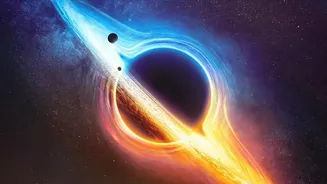


A Trio of Cosmic Monsters
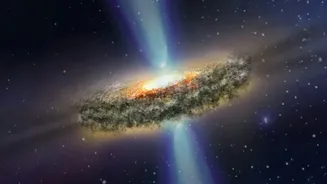
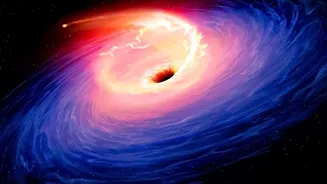
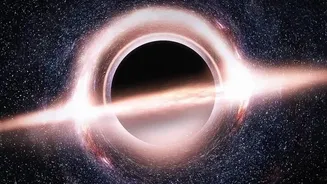
In a galaxy designated J0148-4214, more than 12.5 billion light-years away, astronomers have identified what appears to be a triple system of actively feeding supermassive black holes. This means we are seeing the galaxy as it was just 1.2 billion years after
the Big Bang. An international team led by the Max Planck Institute for Extraterrestrial Physics used the Webb telescope to spot the tell-tale signs. Two of the black holes are huddled close together near the galaxy's center, while a third lurks farther out. Their masses are staggering, estimated at approximately 80 million, 2 million, and 600,000 times the mass of our Sun.
Webb's Unprecedented View
Directly imaging these black holes is impossible due to their immense distance. Instead, scientists used Webb's Near-Infrared Spectrograph (NIRSpec) to analyze the light from the galaxy. They looked for the signature of extremely fast-moving hydrogen gas, which creates what is known as a broad emission line. This high-velocity gas is a clear fingerprint of matter being pulled into a black hole's powerful gravitational grip. The instrument was so sensitive that it could spatially separate the light signatures, revealing that the chaotic motion wasn't coming from one source, but three distinct locations.
Cosmically Close Quarters
The headline notes that two of the black holes are just 190 parsecs apart. A parsec is a unit of astronomical distance equal to about 3.26 light-years, so this separation is roughly 620 light-years. While that sounds vast, for two supermassive black holes, it is incredibly close. It suggests they are in the late stages of a galactic merger, spiraling toward an eventual collision. The third black hole is located much farther out, about 5,500 light-years from the central pair. Finding such a tight configuration in the early universe is a landmark discovery.
Why This Discovery Matters
Finding a triple system provides a crucial missing link in our understanding of how galaxies and their central black holes grow. A major puzzle in astronomy is how supermassive black holes got so big, so quickly in the early universe. While they grow by consuming gas and dust, that process alone may not be fast enough. This discovery provides strong evidence that mergers are a key part of the answer. When galaxies collide, their central black holes sink toward the new center and eventually merge, creating an even more massive black hole. Seeing three together suggests a complex history of multiple galactic collisions.
An Inevitable Collision
The two central black holes are on a collision course. Astronomers estimate they will merge within the next few hundred million years. As they get closer, they will stir up the space around them before finally combining in a cataclysmic event that will unleash powerful gravitational waves across the cosmos. The fate of the third, more distant black hole is less certain. It might be slowly migrating inward for a future merger, or it could be a remnant of a past interaction that was kicked out from the center.