




A Cosmic Mystery
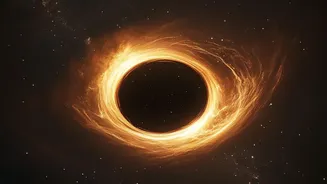
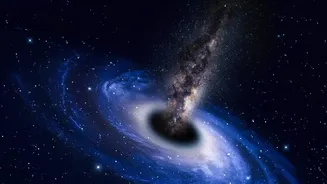
For decades, one of the biggest puzzles in cosmology has been the existence of supermassive black holes in the very early universe. Standard theories suggest it takes a long time for a black hole to grow to millions or billions of times the mass of our
sun. Yet, astronomers have found these giants lurking at the heart of galaxies that existed less than a billion years after the Big Bang. How did they get so big, so fast? It’s a question that has sent scientists searching for a missing piece in the cosmic timeline. The conventional story is that the first stars ignited, lived, and died, collapsing into smaller, stellar-mass black holes. These then gradually merged and consumed gas over aeons to grow into the behemoths we see today. But the timeline doesn't quite add up, suggesting that either they grew much faster than believed possible, or they had a different, more dramatic origin story.
Enter the 'Black Hole Star'
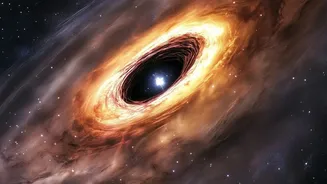
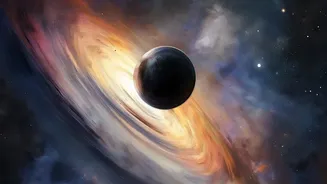
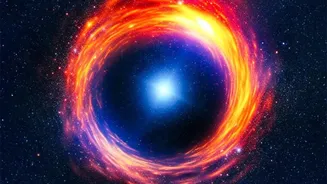
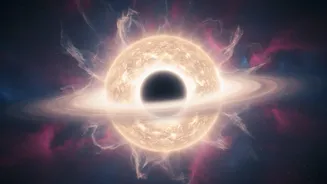
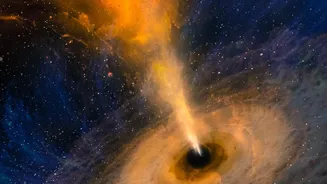
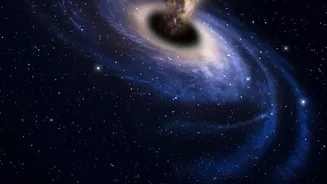
Recent observations from the James Webb Space Telescope (JWST) have introduced a radical new candidate to solve this puzzle: the 'black hole star', also known as a quasi-star. This is a hypothetical type of object, first theorized in 2006 but never seen until now. Unlike a normal star, which is powered by nuclear fusion in its core, a quasi-star would get its immense energy from a black hole at its center. The idea is that in the dense, primordial gas clouds of the early universe, a massive protostar could have collapsed at its core to form a black hole, while its vast outer layers remained intact, absorbing the initial explosive energy. This would create a bizarre hybrid: an object that looks like a gigantic, luminous star but is powered by matter falling into a central black hole.
Spotting the Unseen
Astronomers spotted what they believe to be the first of these objects after focusing the JWST on a mysterious, extremely bright red dot in the early universe, nicknamed MoM-BH*-1. This object, existing just a few hundred million years after the Big Bang, is about the size of our solar system but shines with the energy of 100 billion suns—far more than any normal star could produce. Its unique light signature, which is intensely red and lacks certain wavelengths, doesn't match any known type of star or galaxy. The most plausible explanation, according to the research team, is that they are looking at a nascent black hole shrouded in such a dense cocoon of gas that it radiates like a star. This discovery suggests that many of the other mysterious 'little red dots' seen in JWST’s deep-field images might also be these strange black hole stars.
Rewriting the Cosmic Playbook
If confirmed, the existence of black hole stars would provide a direct pathway for the rapid formation of supermassive black holes. Instead of starting small and growing slowly, these objects would essentially be born as large seeds, with a core black hole already containing thousands of solar masses. They would have had short but brilliant lives, lasting maybe a few million years as the central black hole consumed the surrounding stellar envelope, growing rapidly in the process. Once the gas ran out, what would be left behind is an intermediate or supermassive black hole, perfectly explaining how such giants could appear so early in cosmic history. This provides a crucial, previously missing link between the universe's first stars and the colossal black holes that anchor galaxies like our own Milky Way today.