




What Are Hanging Glaciers?
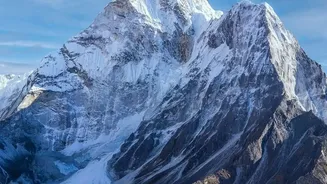
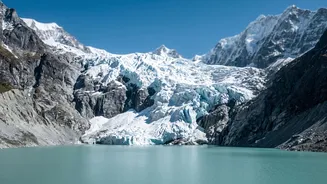
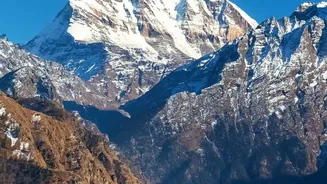
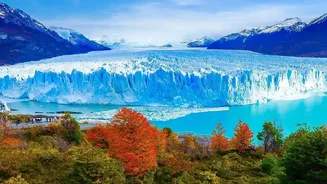
A hanging glacier is an ice mass that originates high on the wall of a mountain valley but stops abruptly, often at a cliff edge, rather than flowing down to the valley floor. Unlike valley glaciers that move slowly downwards, hanging glaciers are perched
in precarious positions. Their instability makes them highly susceptible to the effects of climate change. An ongoing assessment by glaciologists has identified at least 858 such glaciers along India's Himalayan stretch, while a focused April 2026 study published in 'Nature' mapped 219 in Uttarakhand's Alaknanda basin alone. These formations are essentially frozen reservoirs waiting for a trigger to release their immense energy.
The Threat of a Cascading Disaster
The primary danger of a hanging glacier is not just the ice itself, but the chain reaction, or 'cascading disaster', it can unleash. When a hanging glacier breaks off, it triggers a massive ice and rock avalanche. This initial event can then cause a sequence of secondary hazards. The falling mass can crash into a glacial lake, causing a glacial lake outburst flood (GLOF) that sends a wall of water downstream. Alternatively, the avalanche can block a river, forming a temporary dam. When this dam inevitably bursts, it results in a devastating flash flood. This entire sequence, from icefall to flood, can happen within hours, leaving little time for warning. The 2021 Chamoli disaster, which killed over 200 people, was the result of such a chain reaction initiated by a falling wedge of rock and hanging glacier.
The Climate Change Connection
The increasing instability of these glaciers is directly linked to a warming climate. Himalayan temperatures are rising, causing the ice to weaken. Parts of these glaciers are often frozen to the bedrock, which keeps them attached to the steep slopes; but as temperatures rise, this bond weakens. This process, combined with changes in freeze-thaw cycles and shifting rainfall patterns, makes catastrophic break-offs more likely. Experts now warn that as the planet warms, the conditions that destabilise both ice and rock are becoming more widespread across the Himalayas, turning what was once a predictable natural process into an urgent and growing hazard.
Identifying the High-Risk Zones
Recent research has begun to pinpoint the most vulnerable areas. The Alaknanda basin in Uttarakhand, home to crucial pilgrimage sites like Badrinath, has been identified as a hotspot. Studies show that nearly a third of the unstable ice mass in the basin is concentrated in its upper reaches. Simulations have indicated that an avalanche from a hanging glacier in the Badrinath-Mana sector could create a flow of debris more than 50 metres high, overwhelming major settlements and infrastructure. The risk is compounded by rapid development in these high-altitude areas. One study projected that by 2030, the amount of infrastructure at risk from these avalanches in the Alaknanda basin will increase by 120% compared to the year 2000, with the exposed population growing significantly.
The Race to Monitor and Prepare
The challenge for India is shifting from a reactive disaster response to an anticipatory one. Unlike glacial lakes, which can be monitored for changes in water level, hanging glaciers can detach without clear warning signs, making prediction difficult. Experts are calling for systematic identification and monitoring of high-risk glaciers using satellite technology and other tools. This includes creating detailed inventories, like the one for the Alaknanda basin, and developing risk-informed land-use plans to guide development away from potential avalanche paths. The goal is not to predict every single avalanche, but to understand the overall risk and reduce the chances of a foreseeable mountain hazard becoming an avoidable human catastrophe.