



A Question of Density, Not Size
First, let's separate mass, size, and density. An object's mass is how much 'stuff' it contains, while its size (or volume) is how much space it takes up. Density is the relationship between the two: mass divided by volume. A kilogram of lead is small
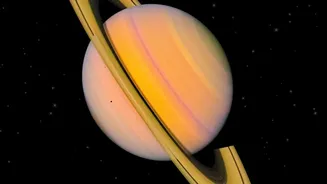
and dense, while a kilogram of feathers is enormous and not dense at all. Saturn is a perfect example of this principle on a planetary scale. It's incredibly massive—over 95 times the mass of Earth—but its volume is even more staggering, at more than 760 times that of our home planet. This means all that mass is spread out over a huge amount of space, leading to a very low average density.
The Numbers Don't Lie
The average density of Saturn is approximately 0.687 grams per cubic centimetre. In contrast, the density of liquid water is about 1 gram per cubic centimetre. This makes Saturn the only planet in our solar system with an average density lower than water. According to Archimedes' principle, any object placed in a fluid that is less dense than the fluid itself will float. So, scientifically speaking, the 'floating planet' claim holds true. For comparison, Earth, the densest planet, has an average density of about 5.51 grams per cubic centimetre, while even fellow gas giant Jupiter is denser than water at 1.33 grams per cubic centimetre. They would both sink.
The Anatomy of a Gas Giant
So, why is Saturn so light for its size? The answer lies in its composition. Saturn is a gas giant, primarily made of the two lightest elements in the universe: hydrogen and helium. Its atmosphere is estimated to be about 96% hydrogen and 3-4% helium, with trace amounts of methane and ammonia. Unlike rocky planets such as Earth or Mars, Saturn does not have a solid surface. Instead, its gaseous outer layers transition into deeper, denser layers of liquid hydrogen and even metallic hydrogen under intense pressure. While Saturn is believed to have a dense, hot core of rock and metal at its very centre, this core makes up a relatively small part of the planet's overall volume. The vast, puffy envelope of gas is what dominates its profile and brings its average density way down.
The Giant Bathtub Conundrum
The idea of a Saturn-sized bathtub is, of course, a fun thought experiment. A tub wide enough to hold the planet would need to be over 120,000 kilometres across. More importantly, a body of water that large would collapse under its own gravity, becoming a spherical water-world itself. Some physicists also point out that while the average density is low, Saturn is not a single, solid object. If placed in a hypothetical ocean, its lighter gases would likely disperse, while its denser core would sink. So, the planet wouldn't float peacefully like a giant, ringed beach ball. However, the analogy perfectly illustrates a fundamental and surprising truth about its physical nature.
What Density Tells Us
Saturn’s low density isn’t just a fun fact; it's a crucial clue about the formation of our solar system. Gas giants like Saturn and Jupiter formed in the colder, outer regions of the early solar system. In this frigid environment, far from the Sun, there was an abundance of light gases like hydrogen and helium that could be gravitationally swept up by the forming planets. Rocky planets like Earth formed closer to the Sun, where solar winds had blown away most of these lighter elements, leaving behind heavier, denser materials. Saturn's fluffy nature is a direct consequence of where and how it was born, making it a relic of the solar system's early history.