









The Cloud's Physical Footprint
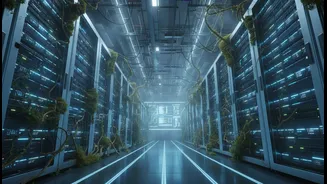
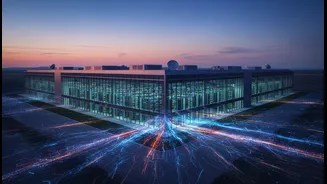
For something that sounds as light as a cloud, its physical home is anything but. Data centres are vast, factory-like buildings filled with tens of thousands of computer servers, all processing, storing, and moving the data that underpins our modern lives.
These digital warehouses are the engines of the internet, and like any engine, they consume a colossal amount of energy. A significant portion of this power, often 30-40%, isn't even for computing; it's for cooling. Servers generate immense heat, and keeping them from overheating requires constant, energy-intensive air conditioning or water-based cooling systems. This dual demand for power—for computation and for cooling—is at the heart of the data centre's growing environmental footprint.
An Insatiable Appetite for Energy
The scale of energy consumption is staggering and accelerating rapidly. As of 2024, data centres accounted for about 1.5% of global electricity consumption, but this figure is set to explode. Projections from Gartner suggest global data centre electricity use will jump by 26% in 2026 alone. To put it in perspective, the International Energy Agency (IEA) projects that by 2030, global data centre electricity demand will be slightly more than the entire current consumption of Japan. In countries like the United States, data centres could account for as much as 12% of the nation's total electricity use by 2028. This isn't a distant problem; in India, the booming data centre market is expected to see its energy and water use more than double by 2030, placing immense strain on already stretched resources.
The AI and Generative AI Accelerator
For years, efficiency gains in computing hardware helped keep data centre energy consumption relatively flat despite increasing workloads. That era is over, largely due to the rise of Artificial Intelligence. Training and running large AI models is an incredibly power-intensive process. Servers optimized for AI can consume two to four times more energy than their conventional counterparts. One estimate suggests training a single complex AI model can emit as much carbon as five cars over their entire lifetimes. According to the IEA, AI workloads are the single most important driver of growth in data centre energy demand, projected to account for almost half of the net increase between 2024 and 2030. This explosive growth means that by 2027, AI-optimized servers are expected to consume more power than all conventional servers combined.
Where Does the Power Come From?
The surge in electricity demand would be less of a climate concern if it were all met by renewable sources. While major tech companies are making significant investments in wind and solar power, the reality is that many data centres are still tethered to grids powered by fossil fuels. This directly links digital activity to greenhouse gas emissions. In the U.S., the average carbon intensity of electricity used by hyperscale data centres was found to be nearly 50% higher than the national grid average, reflecting their location in regions with less clean energy. The result is a growing contribution to global emissions, with the IEA forecasting that CO2 emissions from data centres could rise from 180 million tonnes today to 300 million tonnes by 2035 in its base case scenario. The challenge is that the demand for power is growing so fast that it often outpaces the construction of new renewable energy infrastructure, forcing reliance on existing, often carbon-heavy, sources.
The Race for Sustainable Solutions
The industry is acutely aware of this challenge, which is now a constraint on growth itself. The search for solutions is a multi-front effort. Companies are innovating with more efficient cooling technologies, such as moving from air to liquid cooling, which is more effective for the high-density computing that AI requires. There is also a push towards designing smaller, more efficient AI models that consume less power to run. On the energy supply side, tech giants are among the largest corporate buyers of renewable energy, signing long-term agreements to fund new wind and solar farms. However, these efforts are in a constant race against the exponential growth in demand. In India, for instance, where the data centre sector is expanding rapidly, there are calls for national policy frameworks to enforce sustainability benchmarks, as planning is currently fragmented across states with little focus on the environmental impact.