




A New Eye on the Cosmos
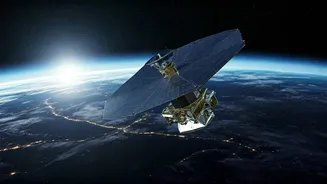
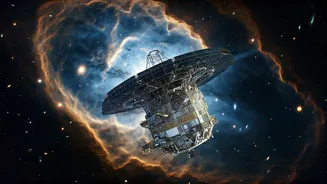
NASA's Nancy Grace Roman Space Telescope represents a new frontier in astrophysics. Named after Nancy Grace Roman, NASA's first chief of astronomy and the 'mother' of the Hubble Space Telescope, this observatory is designed to tackle some of the most
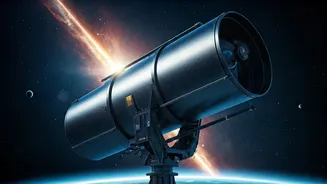
pressing questions in cosmology. The mission, previously known as the Wide Field Infrared Survey Telescope (WFIRST), was designated as the top-priority large space mission by the 2010 Astronomy and Astrophysics Decadal Survey. It features a primary mirror that is 2.4 meters (7.9 feet) in diameter, the same size as Hubble's, but with a significant upgrade. Its Wide Field Instrument will provide a field of view at least 100 times larger than Hubble's infrared camera, allowing it to capture vast swathes of the sky with unprecedented speed and efficiency. A single image from Roman will contain the detail equivalent to 100 Hubble pictures.
Hunting Dark Energy and Exoplanets
The Roman telescope has two primary scientific goals: understanding the nature of dark energy and discovering new exoplanets. It will investigate dark energy, the mysterious force thought to be causing the universe's expansion to accelerate, by mapping the distribution of billions of galaxies and observing distant supernovae. In the search for worlds beyond our solar system, Roman will conduct a massive survey using a technique called gravitational microlensing. This method is sensitive enough to find exoplanets with a wide range of sizes and orbits, including those far from their host star. Scientists anticipate Roman will discover thousands of new exoplanets, providing a statistical census of planetary systems in our galaxy. In addition to its wide-field surveys, Roman carries a technology demonstrator called the Coronagraph Instrument, designed to directly image giant exoplanets by blocking the overwhelming light from their host stars.
The Heavy-Lift Champion
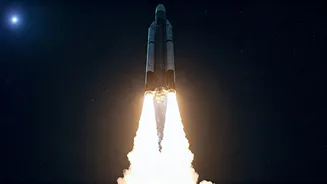
To send the nearly 18,000-pound observatory to its destination 1.5 million kilometers from Earth, NASA has selected one of the most powerful rockets in operation: SpaceX's Falcon Heavy. Comprised of three modified Falcon 9 first-stage boosters strapped together, the Falcon Heavy generates over 5 million pounds of thrust at liftoff, equivalent to about eighteen 747 aircraft. Since its famous maiden flight in 2018, which launched Elon Musk's Tesla Roadster into space, the Falcon Heavy has built a reputation for reliability, successfully launching critical payloads for the U.S. Space Force and other NASA missions, including the Psyche asteroid probe and the Europa Clipper. Its immense lift capacity makes it one of the few vehicles capable of sending a flagship observatory like Roman on its journey to the second Sun-Earth Lagrange point (L2), a gravitationally stable location ideal for deep-space observations.
A Landmark Commercial Partnership
The selection of the Falcon Heavy represents a significant moment in the partnership between NASA and the commercial space industry. In 2022, NASA awarded SpaceX a contract valued at approximately $255 million for the launch service. This decision highlights the agency's increasing reliance on private companies to provide critical services, allowing NASA to focus its resources on designing and building complex scientific instruments. The Roman mission is now in its final stages of preparation. The completed telescope arrived at NASA's Kennedy Space Center in Florida in late June 2026, marking the beginning of final prelaunch processing. The launch is targeted for no earlier than August 30, 2026, from Launch Complex 39A, the same pad that sent Apollo astronauts to the Moon. This launch date puts the mission an impressive eight months ahead of its original schedule, a testament to the hard work of the thousands of engineers and scientists involved.