









From Manual Agony to Automated Accuracy
For decades, verifying a property title in India has been a manual, time-consuming process involving lawyers sifting through stacks of deeds and government records, often in various regional languages. Similarly, road maintenance has been largely reactive,
depending on citizen complaints or slow manual surveys to identify and fix potholes. This is now changing, as startups leverage AI to bring speed, transparency, and efficiency to these critical sectors. Supported by government initiatives like the IndiaAI Mission, which aims to build a robust AI ecosystem, these tools are moving from small-scale pilots to everyday civic work. The goal is to create systems that can handle the massive scale of India's infrastructure, from its millions of kilometers of roads to its billions of property documents.
Untangling the Knot of Property Verification
India’s system of presumptive property titling means the burden of proving ownership falls on the buyer, a process complicated by fragmented, state-specific land record systems. AI-powered platforms are emerging to solve this. Companies like Landeed, Deedwise, and BhoomiScan have developed tools that use AI to digitize and analyze vast quantities of property documents. These systems use Optical Character Recognition (OCR) to read scanned deeds, and Natural Language Processing (NLP) to understand complex legal terms and trace the chain of ownership. By cross-referencing information from different government databases, these platforms can flag inconsistencies, identify potential fraud, and verify encumbrances in minutes—a task that would traditionally take lawyers days or weeks. Some platforms are even trained on documents in specific regional languages, like Kannada, to navigate local record systems with greater accuracy.
Paving the Way with Smarter Road Repairs
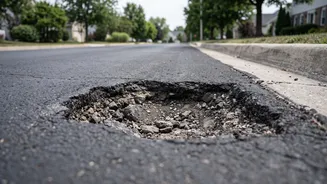
On the infrastructure front, AI is being deployed to proactively manage India's vast road network. Startups are using computer vision models trained on hundreds of thousands of images of Indian roads to automatically detect and classify damage. In Bengaluru, the municipal government has launched an AI-powered application that uses footage from cameras mounted on city vehicles to identify potholes in real-time. The system automatically generates GPS coordinates, assesses the severity of the damage, and can even create work orders for repair contractors without manual intervention. Other companies, like Rasta.AI and DigiInfra AI, have developed similar technologies that not only spot existing potholes but also use machine learning to predict where new ones are likely to form, enabling a shift from reactive fixes to proactive maintenance. These systems can help authorities reduce inspection costs and prioritize repairs more effectively, ultimately making roads safer.
The Road Ahead for Civic AI
While the potential is enormous, the path to large-scale adoption has its challenges. For property verification, success depends on the quality and digitization of government records, which can vary significantly between states. For road maintenance, the physical verification of defects by engineers is still often required to validate the AI's findings. Furthermore, scaling these solutions requires significant investment and buy-in from municipal and state governments across the country. However, the progress is undeniable. Several startups have already launched commercial partnerships with state governments, processing millions of property records and scanning hundreds of thousands of kilometers of roads. These tools are no longer just concepts; they are actively being integrated into civic workflows, demonstrating a clear path toward more efficient, transparent, and responsive public services.