




The Classic Story of a Cosmic Crash
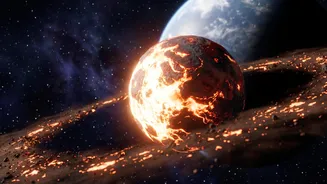
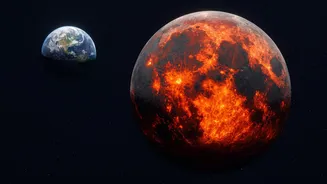
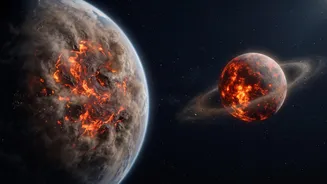
The most widely accepted theory for the Moon's origin story is as epic as it gets. Known as the Giant-Impact Hypothesis, it proposes that about 4.5 billion years ago, the very young Earth was struck by a Mars-sized protoplanet named Theia. The collision
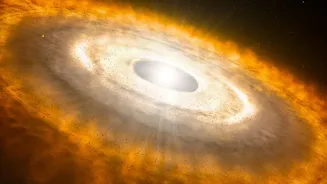
was catastrophic, obliterating Theia and blasting a massive cloud of molten rock and vapor into orbit around Earth. According to this long-standing model, this debris formed a vast, hot disk. Over a long period—perhaps months or even thousands of years—the material in this disk gradually clumped together, a process called accretion, eventually forming the Moon we know today. This theory elegantly explained many things, including the Moon's size and its orbit around our planet.
A Lingering Cosmic Mystery
Despite its success, the classic Giant-Impact Hypothesis had a significant flaw. The model predicted that since the Moon formed mostly from the debris of Theia, its composition should be very different from Earth's. However, when Apollo astronauts brought back lunar rocks, scientists made a startling discovery: the Moon and Earth are isotopically almost identical. Their rocks share the same chemical fingerprints for elements like oxygen, titanium, and tungsten, making them look like twins. This similarity is highly unusual, as other bodies in the solar system, like Mars, have distinctly different isotopic signatures. To explain this, either Theia had to be an unlikely twin of Earth to begin with, or the impact needed to cause a far more thorough mixing of materials than simulations could account for.
Supercomputers Enter the Picture
This is where modern technology changes the game. Researchers at institutions like NASA's Ames Research Center and Durham University began running new, much more powerful simulations of the ancient impact. These weren't just slightly better versions of old models; they were run at incredibly high resolutions, using up to 100 million particles to represent the colliding planets. Crucially, these new simulations began to factor in something previously overlooked: the material strength, temperature, and geology of the proto-Earth and Theia. Earlier models often treated the colliding planets like fluids of molten rock, assuming their internal strength wouldn't matter in such a violent event. The new results showed this was a critical miscalculation.
A Moon in a Matter of Hours
The results were stunning. When simulations were run with the right conditions—specifically, a hotter, mostly solid Theia—they produced a radically different outcome. Instead of creating a debris disk, the impact could launch a large, partially molten chunk of Earth's mantle directly into a stable orbit. This massive body, containing a significant amount of Earth material, would have then quickly pulled itself into a spherical shape. The entire process, from impact to a recognizable proto-Moon, could have taken as little as five hours. This 'immediate formation' scenario suggests the Moon wasn't slowly built from rubble but was born almost instantly from the collision's wreckage.
Why This New Model Fits Better
The 'Moon in a few hours' model provides a compelling solution to the isotopic mystery. Because the satellite is formed largely from Earth's own mantle material, it naturally explains why their compositions are so similar. There's no need to assume Theia was a perfect twin or to invoke a complex and complete mixing process. Furthermore, this rapid-formation pathway can also account for other puzzling features, such as the Moon’s tilted orbit and its thin crust. The temperature of the colliding bodies seems to be a key factor. A hotter, earlier collision in the solar system's history would favor this immediate-formation pathway, while a cooler, later impact might still result in the classic debris disk.