






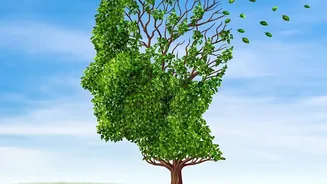
The Myth of the Perfect Recording
Most of us think of memory as a mental filing cabinet, where experiences are stored as complete, unchangeable files. You experience an event, your brain records it, and when you need to remember, you simply pull out the file and hit 'play.' But decades
of psychological and neurological research have shown this model to be almost entirely wrong. Memory isn't a recording; it's a reconstruction. Every time you recall an event, your brain actively rebuilds it from fragments of information. This process is influenced by your current mood, existing beliefs, and even subtle suggestions from others. This is why two people can have vastly different recollections of the same shared experience.
Every Recall is a Rewrite
The process of memory being rebuilt is known in neuroscience as 'reconsolidation'. When you access a memory, the neural pathways that represent it become temporarily flexible before being stored again. This brief window allows the memory to be updated with new information or emotions. Think of it less like opening a document in 'read-only' mode and more like opening a Wikipedia page where you—and others—can make edits. While this malleability allows us to learn and adapt, it's also the mechanism behind why our memories can change over time, sometimes incorporating details that never happened. This happens because the brain often prioritizes a coherent story over perfect, moment-to-moment accuracy.
What Recent Research Tells Us
The world of memory research is constantly evolving. Recent studies continue to add nuance to our understanding. For instance, new research highlights that significant shifts in memory accuracy may begin as early as middle age, not just in old age as commonly believed. One 2026 study found that when older adults make memory mistakes, it's not because their brain is failing to activate; it's because it remains highly active but starts to jumble details together, incorrectly binding different pieces of information. Other recent work in 2026 has explored how the brain separates the 'what' of a memory from its context ('where' and 'when'), storing them in different neural groups and linking them during recall. This separation helps us apply knowledge across different situations but can also be a point of failure, leading to mix-ups.
The Trouble with False Memories
The reconstructive nature of memory means we are all susceptible to forming 'false memories'—recollections of events that feel vivid and real but are partially or wholly incorrect. This can happen in several ways. The misinformation effect, famously studied by psychologist Elizabeth Loftus, shows how hearing misleading information after an event can corrupt our memory of it. Repeatedly telling a story can also introduce small changes that become part of the memory itself. Research has even shown that shared false memories can emerge in groups, where exposure to misinformation alters the recollections of multiple individuals in similar ways. Crucially, confidence is not a reliable indicator of accuracy; you can feel completely sure about a memory that is factually wrong.
Can We Trust Our Memories At All?
After learning all this, it's easy to feel like your memory is fundamentally broken. But that's not the right way to look at it. Our memory system wasn't designed for flawless factual recall over decades. It evolved to help us learn, navigate the future, and build a sense of identity. Its flexibility is a feature, not just a bug. It allows us to generalise from past experiences and imagine future possibilities. While it's wise to be humble about the precision of our recollections, especially from the distant past, our memories still serve us well. Understanding their limits helps us become more critical thinkers and, perhaps, more forgiving participants in disagreements over who-remembers-what.