




The Building Blocks Emerge
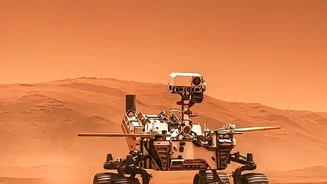
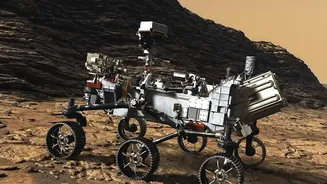
In recent months, both the Curiosity and Perseverance rovers have transmitted game-changing data from the Martian surface. In Jezero Crater, a region believed to have once been a vast lake, the Perseverance rover identified a treasure trove of complex
organic molecules. These carbon-based compounds, including some ring-shaped structures, are fundamental to all known life on Earth. These molecules were found preserved in rocks that also show evidence of sustained interaction with water. The discovery of macromolecular carbon, specifically, is significant because on Earth, such materials are often associated with the fossilised remains of microbial life. However, these molecules can also be formed through non-biological geological processes or delivered by meteorites, making their origin uncertain for now.
A Watery, Dynamic Past
It’s not just about the chemicals; it’s about the environment that preserved them. Multiple studies have confirmed that Jezero Crater was a dynamic place, with a history far more complex than initially imagined. Evidence points to a persistent lake and river delta system, along with subsurface hydrothermal activity where water circulated through rocks over vast timescales. Some of the minerals found, like sepiolite, suggest a shift from harsher, acidic conditions to more neutral, alkaline waters—a change that would make the environment increasingly supportive of life. These findings paint a picture of a planet that wasn't just briefly wet, but one that hosted multiple, long-lasting habitable environments where the key ingredients for life were present. This moves the scientific conversation from asking if Mars was habitable, to investigating how far its chemistry progressed toward life.
Why This Isn't Proof of Life
This is the crucial distinction that scientists are keen to emphasise. Finding organic molecules and signs of ancient water is not the same as finding evidence of ancient Martians. The instruments on the rovers are sophisticated, but they cannot definitively determine whether these carbon molecules were created by biological or non-biological processes. The bar for proving extraterrestrial life is extraordinarily high. While some of the evidence, like certain carbon signatures, mimics patterns left by microbes on Earth, the same signatures can be created by geological activity. Think of it as finding flour and water in a kitchen. It suggests someone could have made bread, but it isn't proof of a finished loaf. Until we can analyse these samples in advanced laboratories on Earth, the question of their origin remains open.
India's Eyes on the Sky
This global quest for answers on Mars resonates strongly with India's own impressive space ambitions. The success of the Indian Space Research Organisation's (ISRO) Mars Orbiter Mission, Mangalyaan, which entered Martian orbit in 2014, cemented India's place as a major player in interplanetary exploration. Mangalyaan's primary goal was to showcase India's technological capability and study the Martian atmosphere and surface features. While different in scope from the life-hunting rover missions, it was a landmark achievement that inspires a new generation of Indian scientists and engineers. Every discovery by Perseverance or Curiosity adds to a global pool of knowledge that missions like Mangalyaan helped build, reminding us that the search for life beyond Earth is a shared human endeavour.
The Next Frontier: Sample Return
So, what’s next? The ultimate answer to the life-on-Mars question lies in getting a piece of the planet back to Earth. The Perseverance rover has been diligently collecting and caching rock and soil samples in airtight titanium tubes. The original plan, a joint NASA-European Space Agency mission called Mars Sample Return, was designed to retrieve these tubes in the 2030s. However, recent budget uncertainties have put the mission's future in doubt. This makes the rover's on-site analysis even more critical, but for now, the definitive proof that everyone is hoping for remains sealed in tubes, waiting on the Martian surface for a ride home. These samples represent our best chance to finally analyse Martian geology with the full power of Earth-based labs and perhaps, finally, answer one of humanity’s oldest questions.