




An Ocean World's Icy Gift
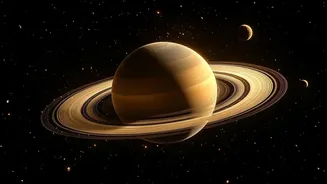
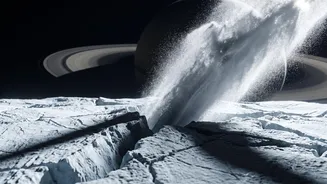
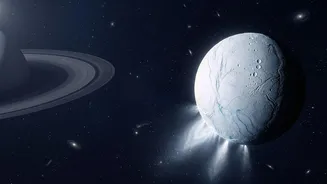
Enceladus, one of Saturn's nearly 300 known moons, has long captivated scientists. Beneath its gleaming white shell of ice lies a global ocean of liquid saltwater. What makes Enceladus truly special are the massive plumes of water vapor and ice particles
that erupt from deep fractures near its south pole, nicknamed 'tiger stripes'. These geysers shoot material from the subsurface ocean hundreds of kilometres into space, offering a unique opportunity for spacecraft to sample the ocean's contents without the immense challenge of landing and drilling through kilometres of ice. Data from NASA's Cassini mission, which flew through these plumes, confirmed the presence of salts, organic molecules, and even molecular hydrogen—a potential energy source for microbial life. This tantalising trifecta of liquid water, organic chemistry, and an energy source makes Enceladus a top candidate for habitability in our solar system.
The Preservation Puzzle
Finding a potentially habitable environment is one thing; finding definitive proof of life is another. The key is detecting biosignatures—complex molecules like amino acids that are the building blocks of proteins. A major challenge has been whether these delicate molecules could survive the violent journey from the ocean, through the plumes, and into the detectors of a passing spacecraft. Furthermore, even if they survived, they might be so diluted in the vast ocean that they would be impossible to detect in tiny ice grains. It was a significant hurdle: if the evidence is destroyed or too faint to register, a life-detection mission could come up empty even if life exists there.
A Natural Sorting System
This is where the new breakthrough, detailed in recent studies in the journal Science Advances, changes the game. An international team of researchers conducted laboratory experiments and re-analysed Cassini data to understand what happens to ocean droplets as they freeze. They found that contrary to previous assumptions of rapid freezing, the droplets likely freeze slowly as they travel up through the moon's ice shell. This slow-freezing process causes different dissolved chemicals, like salts and organics, to separate and become concentrated in distinct regions within the larger frozen droplet. These droplets then shatter into smaller, micrometre-sized ice grains before being ejected into space. The result is that instead of each grain being a tiny, uniform sample of the ocean, some grains can be highly concentrated with specific compounds, including potential biosignatures. Effectively, Enceladus itself may be sorting and concentrating the very evidence scientists hope to find.
Good News for Future Missions
These findings have profound implications for future missions designed to search for life. It means that a probe flying through the plumes would have a much better chance of detecting biosignatures because they could be packed densely into a small number of individual ice grains. This makes the task of detection significantly easier for the instruments aboard a spacecraft. Several missions to this icy moon have been proposed, including NASA's Enceladus Orbilander, which would orbit the moon sampling its plumes before landing on the surface. The new research strengthens the scientific case for such ambitious projects, suggesting that existing technology could be capable of identifying signs of life if it's there. One study even showed that an Earthly microbe that thrives near hydrothermal vents could survive in the simulated harsh chemical conditions of Enceladus's ocean.