


What Is Floating Up There?
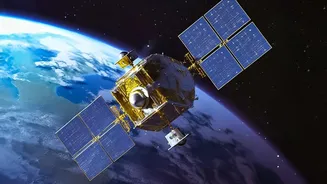
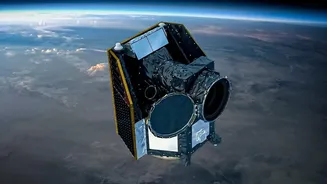
Space debris is the term for any human-made object left in orbit that no longer serves a useful function. This includes everything from entire defunct satellites and spent rocket stages to tiny flecks of paint and frozen coolant. According to the European
Space Agency (ESA) and other trackers, there are over 30,000 pieces of debris larger than a softball regularly tracked from the ground. When you include smaller pieces, the numbers become staggering: statistical models estimate there are over a million objects between 1 and 10 cm, and well over 100 million fragments smaller than 1 cm. In total, the mass of all this material orbiting Earth is estimated to be more than 9,500 tonnes. This junk isn't just floating; it's moving at incredible speeds. In low Earth orbit, objects travel at around 27,000 kilometres per hour. At that velocity, even a 1 cm aluminium sphere carries the kinetic energy of a hand grenade, capable of catastrophically disabling a functioning satellite.
Why Your Personal Risk Is So Small
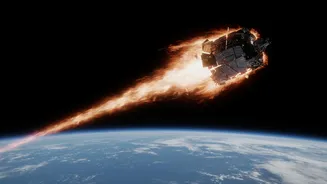
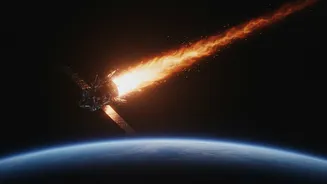
With tonnes of metal falling from the sky, it seems logical to be worried. In reality, the odds of a piece of space debris hitting a person are astronomically low. The primary reason is that Earth is overwhelmingly vast and mostly uninhabited by humans. About 71% of the surface is water. Much of the land is sparsely populated. Furthermore, most debris that de-orbits burns up entirely upon re-entry into the atmosphere due to intense heat from air friction. While larger, denser components can and do survive, the chances of one landing in a populated area are slim. There have been documented cases of debris hitting the ground, such as a large rocket ring found in Kenya, but no officially confirmed human fatality has ever been caused by falling space junk. So, you don't need to add a space helmet to your daily attire. The direct threat to any single individual remains negligible.
The Real Danger: A Crowded Sky
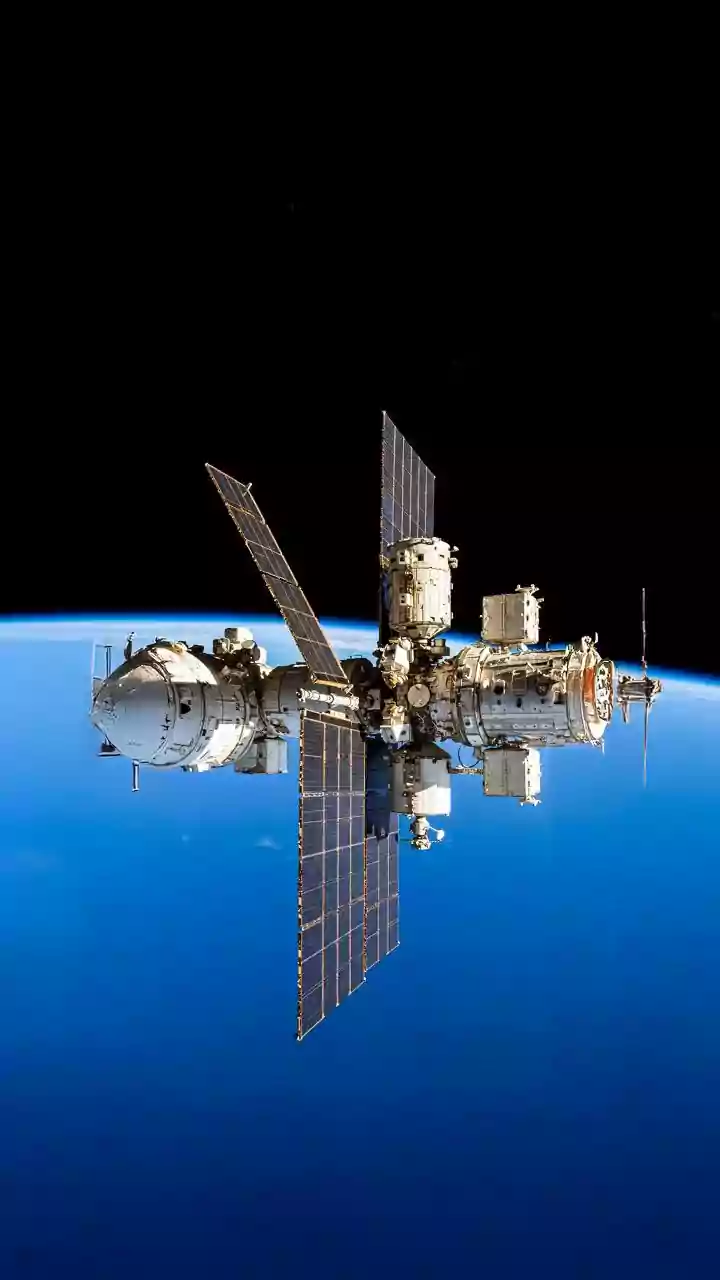
The aggregate risk is a completely different story. The real danger isn't to people on the ground, but to the critical infrastructure orbiting above us. Our modern world runs on satellites. GPS, weather forecasting, global communications, financial transactions, and national security all depend on a functioning network of spacecraft. This is where the rising volume of debris becomes a major problem. Each piece of junk is a potential missile. A single collision can create thousands of new fragments, each capable of causing another collision. This cascading chain reaction is known as the Kessler Syndrome, a scenario proposed by NASA scientist Donald Kessler in 1978. If the density of debris in key orbits reaches a critical point, it could trigger a feedback loop that renders those orbits unusable for generations, effectively trapping us on Earth. Events like the accidental 2009 collision of a defunct Russian satellite with an active Iridium communications satellite proved this is not just a theory.
How Satellite Risk Affects You
The threat to satellites is a direct threat to our daily lives. Imagine your maps app failing, international banking systems grinding to a halt, or weather agencies being unable to track major storms. That is the potential consequence of a runaway debris problem. Satellite operators are already forced to perform evasive manoeuvres to dodge tracked debris, and the frequency of these avoidance actions is increasing. Furthermore, the growth of large satellite 'mega-constellations' by private companies, while expanding internet access, is also rapidly increasing the number of objects in orbit, both active and defunct. More objects mean more potential for collisions, more debris, and a greater overall risk to the vital services we often take for granted. This is the rising aggregate risk: a slow-motion disaster unfolding hundreds of kilometres overhead.
The Hunt for a Solution
Thankfully, the international space community is aware of the problem and is actively working on solutions. Mitigation is the first step. Current guidelines encourage satellite operators to design spacecraft that will naturally de-orbit and burn up within a set period after their mission ends. But mitigation only prevents the problem from getting worse; it doesn't clean up the existing mess. For that, active debris removal (ADR) is required. Various concepts are being developed, from robotic arms and nets that can capture defunct satellites to harpoons and even lasers designed to nudge debris into a decaying orbit. The European Space Agency is backing missions like ClearSpace-1, which aims to demonstrate the feasibility of capturing and removing a piece of debris. These technologies are complex and expensive, but they are seen as a necessary investment to protect the future of space exploration and our reliance on orbital technology.