



The Anatomy of a Hidden Danger
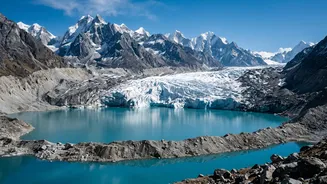
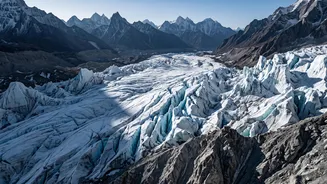
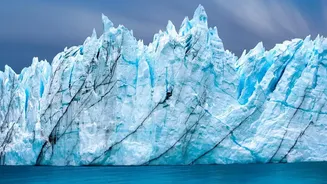
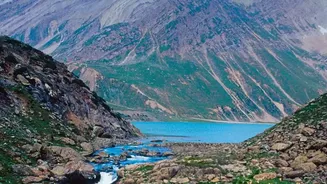
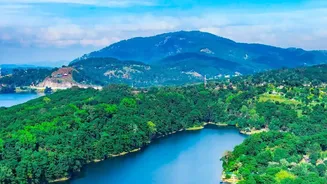
When a glacier retreats, it often leaves behind a depression in the earth. Meltwater fills this void, creating a glacial lake. The problem is the dam. Unlike concrete man-made dams, these natural barriers are typically composed of moraine—an unstable
mixture of loose soil, rock, and debris left behind by the glacier. As the lake grows, water pressure builds on this fragile wall. A number of triggers can cause it to fail catastrophically: an earthquake, a major rainfall event, or a large avalanche of rock or ice crashing into the lake, creating a displacement wave that overtops the dam. The result is a Glacial Lake Outburst Flood, or GLOF, a sudden and violent release of millions of cubic metres of water.
A Torrent That Travels for Miles
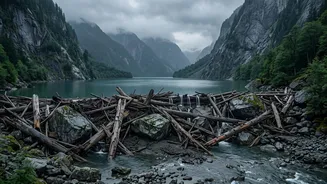
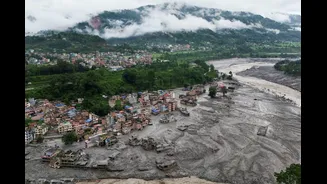
What makes GLOFs so uniquely dangerous is not just the volume of water, but the destructive power it gathers on its journey. As the initial flood bursts from the lake, it picks up the moraine material from the dam itself, scouring the valley floor and transforming into a thick, fast-moving slurry of water, mud, trees, and boulders the size of cars. This torrent can travel at speeds of up to 60 kilometres per hour, destroying everything in its path. The danger extends far beyond the immediate vicinity of the glacier. GLOFs can devastate communities and infrastructure hundreds of kilometres downstream, in places where residents may be completely unaware of the looming threat high above them. In 1929, a GLOF in the Karakoram mountains caused flooding on the Indus River that was measurable 1,200 kilometres away.
The Himalayas: A Global Hotspot
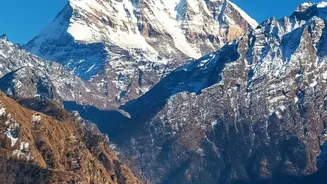
Nowhere is this threat more acute than in the Hindu Kush Himalaya region, often called the “Third Pole” for its vast ice deposits. The region is warming at roughly twice the global average, accelerating glacial melt. As a result, the number and size of glacial lakes are expanding rapidly. A 2023 disaster in Sikkim, India, provided a tragic example. A sudden outburst from the South Lhonak glacial lake sent a wall of water down the Teesta River, claiming dozens of lives, leaving many more missing, and affecting over 88,000 people. The flood's impact was compounded when the torrent destroyed a major hydroelectric dam, releasing even more water. Studies have identified thousands of glacial lakes in the Himalayas, with hundreds considered potentially dangerous, placing millions of people and critical infrastructure at risk.
Racing to Mitigate a Growing Risk
Recognising the escalating danger, governments and scientists are working to get ahead of the threat. The first step is identification: using satellite imagery and field surveys to map and monitor the most hazardous lakes. For lakes deemed a high risk, several mitigation strategies can be employed. These include structural measures like controlled breaching of the moraine dam, pumping out water to lower the lake level, or constructing artificial spillways to manage overflow. However, these engineering solutions are expensive and challenging to implement in remote, high-altitude terrain. Consequently, a major focus is on developing robust Early Warning Systems (EWS). These systems use sensors to detect changes in lake levels or seismic activity that could signal an imminent breach, providing precious time to alert and evacuate downstream communities.