







A Promising 'Super-Earth'
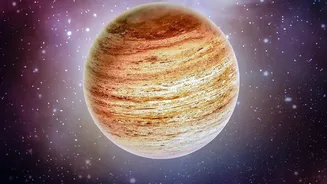
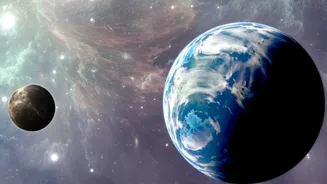
Discovered in 2017, LHS 1140 b quickly became a star in the exoplanet community. It’s what’s known as a super-Earth—a rocky world significantly larger and more massive than our own planet, clocking in at about 5.6 times Earth's mass and 1.7 times its
radius. Crucially, it orbits within the 'habitable zone' of its parent star, a red dwarf named LHS 1140. This is the so-called 'Goldilocks' region where temperatures are just right for liquid water to potentially exist on a planet's surface, a key ingredient for life as we know it. Early estimates of its density suggested it could be a dense rocky planet or even an ocean world, containing a significant amount of water. Its location and size made it one of the best candidates for having conditions suitable for life, and a primary target for further study.
The Telltale Signature of Helium
The latest breakthrough comes not from seeing an atmosphere directly, but by detecting what’s leaking from it. Using the WINERED spectrograph on the Magellan Clay Telescope in Chile, a team of astronomers observed the planet as it transited, or passed in front of, its star. They were looking for the specific signature of helium gas being stripped from the planet's upper atmosphere by the star's radiation. In observations from September 2024, they found a clear signal of helium escaping from LHS 1140 b, providing the first definitive proof that the planet has retained an atmosphere. This is a landmark finding, as it's the first confirmed atmosphere on a rocky planet within a habitable zone. The discovery validates theoretical models that predicted certain exoplanets could have helium-rich atmospheres.
From Water World to What?
The headline of the discovery is exciting: the planet has an atmosphere. However, the details paint a more complex picture. The very presence of escaping helium suggests a large, extended atmosphere that is being 'blown off' by stellar radiation. This changes the leading theory for the planet. Instead of a dense, rocky world with a relatively thin, Earth-like atmosphere over oceans, the data might point to LHS 1140 b being a 'mini-Neptune' or a world with a substantial hydrogen-helium envelope. Previous observations with the James Webb Space Telescope (JWST) in 2024 had already ruled out a purely hydrogen-dominated atmosphere, suggesting a higher-density one possibly made of nitrogen, water, and carbon dioxide. The new helium data adds a critical piece to the puzzle, confirming the atmosphere's existence while also suggesting it is more substantial and volatile than hoped for a truly Earth-like world.
Why This Finding Still Matters
While the idea of a 'mini-Neptune' may sound less exciting than a 'water world,' this discovery is a huge step forward. The fact that LHS 1140 b has held onto any kind of atmosphere for billions of years is significant. Its star, a red dwarf, is known for being volatile and blasting nearby planets with radiation that can strip atmospheres away. The survival of this planet's gaseous envelope, estimated to be over three billion years old, shows that rocky worlds around these common stars can indeed remain viable candidates in the search for life for long periods. This finding refines our search, helping scientists better distinguish between true terrestrial worlds and those that are something else entirely. It proves that our methods for detecting atmospheres, even indirectly, are working and becoming more powerful.
The Power of Advanced Telescopes
This discovery highlights the incredible power of modern astronomical tools and collaborative science. The initial helium detection was made using a ground-based telescope in Chile, showing that flagship space observatories aren't the only players in the game. However, this work is part of a broader effort that heavily involves the James Webb and Hubble space telescopes. LHS 1140 b is a key target of the 'Rocky Worlds DDT' program, a joint initiative to find atmospheric evidence on rocky exoplanets. The synergy between ground-based observations that can spot clues like escaping helium and space-based telescopes like JWST that can analyze atmospheric composition in detail is crucial. It's this technological combination that is finally allowing astronomers to move from simply finding planets to truly characterizing them and assessing their potential for habitability.