



India's pioneering solar mission, Aditya-L1, is already changing how we see the Sun. A recent discovery has challenged a long-held assumption about solar eruptions, providing crucial new evidence that could reshape our understanding of space weather.
India's Watchful Eye on the Sun
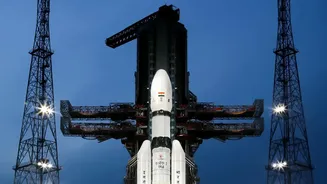
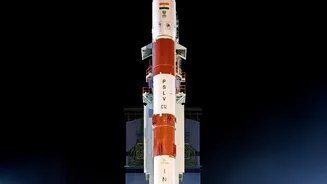
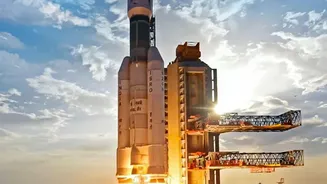
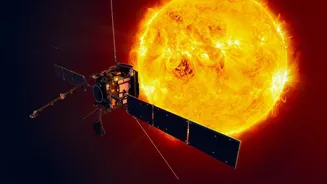
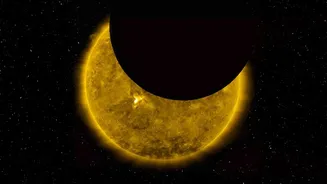
Launched by the Indian Space Research Organisation (ISRO) in September 2023, Aditya-L1 is the nation's first dedicated space-based solar observatory. After a journey of 1.5 million kilometres, it settled into a strategic halo orbit around the Lagrange Point 1 (L1), a point where the gravitational pull of the Earth and the Sun are balanced. This unique vantage point allows the spacecraft to observe the Sun continuously, without any occultation or eclipses, providing an uninterrupted stream of data. The mission carries seven sophisticated payloads designed to study the Sun's various layers, from the photosphere and chromosphere to its outermost corona. The primary goal is to decode the physics of our star and track the explosive phenomena that influence space weather across the solar system.
An Uneven, Lopsided Explosion
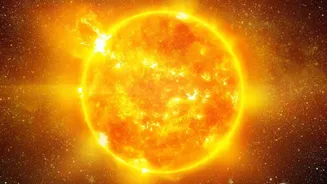
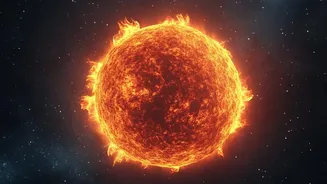
Scientists have long studied Coronal Mass Ejections (CMEs), which are colossal eruptions of plasma and magnetic fields from the Sun's corona. Many models previously assumed these eruptions expand outwards in a relatively uniform, bubble-like shape. However, new findings published in 'The Astrophysical Journal Letters' paint a different picture. Using data from an event observed on August 5, 2024, researchers from the Indian Institute of Astrophysics (IIA) found that this particular CME expanded asymmetrically. Instead of a neat, symmetrical bubble, the eruption was uneven and tilted, stretching and spreading lopsidedly as it travelled away from the Sun.
How VELC Saw What Was Missed
This groundbreaking observation was made possible by Aditya-L1's primary payload, the Visible Emission Line Coronagraph (VELC). While traditional imaging telescopes can track a CME's movement across the sky, VELC has a unique spectroscopic capability. It can measure the Doppler shift in the light emitted by the plasma—detecting whether it is moving towards us (a blueshift) or away from us (a redshift). During the August eruption, VELC detected both blueshifted and redshifted plasma simultaneously, which a simple, symmetrical model could not explain. By combining VELC's data with images from NASA's Solar Dynamics Observatory (SDO) and sophisticated 3D modelling, scientists were able to reconstruct the eruption's true, non-uniform shape.
Why This Asymmetry Matters for Earth
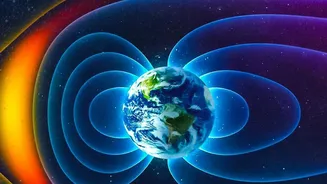
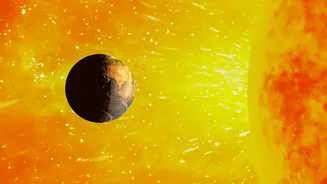
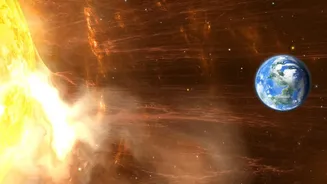
This discovery is more than just an academic curiosity; it has profound implications for predicting space weather. When a CME is aimed at Earth, it can trigger geomagnetic storms that disrupt our planet's magnetic field. These storms can damage satellites, interfere with GPS and communication systems, and even induce currents that can destabilise power grids. Accurately forecasting a CME's arrival time and potential impact is crucial for giving operators time to prepare. The shape of a CME matters because an asymmetric eruption may travel at different speeds and interact with the ambient solar wind differently than a uniform one. Understanding that these eruptions can be lopsided helps refine the models used for forecasting, ultimately leading to more accurate and reliable space weather predictions.
A New Era in Solar Physics
While the study of this single event is a significant step, it is just the beginning for Aditya-L1. Researchers have noted that this is one observation and more data is needed to see how reliably this new understanding can be applied to operational forecasts. Nonetheless, the finding showcases the advanced capabilities of Indian science and technology and marks a major contribution to global solar physics. As Aditya-L1 continues its five year mission, it promises to unravel more of the Sun's secrets, from the mysteries of coronal heating to the dynamics of solar flares and winds. These early results confirm that India's eye on the Sun is poised to revolutionise our understanding of the star that governs our solar system.