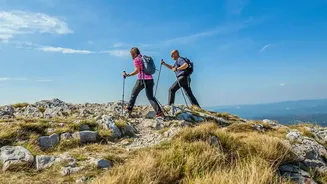







What Exactly Is Nordic Walking?
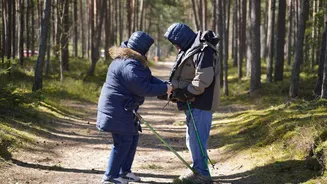
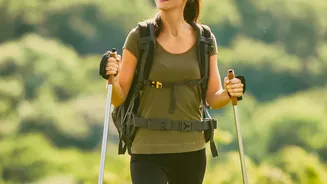
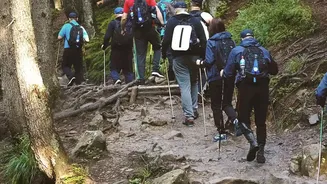
Originating in Finland as a summer training method for cross-country skiers, Nordic walking is a fitness activity that enhances a standard walk with the use of specially designed poles. It's more than just walking with sticks; the technique is about using
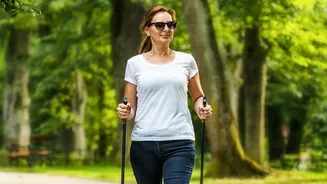
the poles to propel yourself forward. Unlike trekking poles, which are often held in front of the body for stability on uneven terrain, Nordic walking poles are angled and planted behind you. This specific motion is designed to actively engage your upper body, turning a lower-body exercise into a comprehensive, total-body workout.
The Full-Body Workout Advantage
The magic of Nordic walking lies in its ability to engage up to 90% of your body's muscles, compared to just 50% with regular walking. By pushing off the poles with each stride, you activate muscles in your arms, shoulders, chest, back, and core. This increased muscle engagement has significant benefits. It boosts your heart rate and calorie burn by an estimated 20% to 46% more than walking at the same pace, without necessarily feeling much harder. This makes it a highly efficient cardiovascular exercise that also improves posture and builds upper-body strength.
A Champion for Joint Health
For many, high-impact activities like running can be tough on the body. Nordic walking provides a fantastic low-impact alternative. The poles help to distribute your weight more evenly across your whole body, which significantly reduces the load and stress on your lower-body joints, particularly the knees, hips, and ankles. This can make exercise more comfortable and accessible for individuals with joint pain, arthritis, or mobility concerns. The poles also add an element of stability, which can improve balance and confidence while walking outdoors.
Mastering the Basic Technique
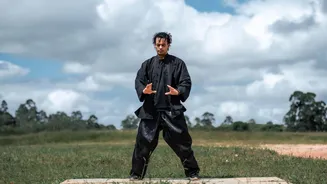
While getting started is easy, proper technique is key to unlocking the full benefits. The fundamental movement coordinates your opposite arm and leg. As your left leg steps forward, your right arm swings forward to plant its pole. Maintain good posture by standing tall with a slight forward lean from the ankles, keeping your shoulders relaxed and your gaze ahead. The poles should be planted behind you at an angle. You push off the pole to propel yourself forward, allowing your hand to open slightly at the end of the arm's backswing. The motion should feel rhythmic and fluid, not forced. Many beginners find it helpful to start by simply dragging the poles to get a feel for the rhythm before actively planting them.
Getting Started: Gear and Guidance
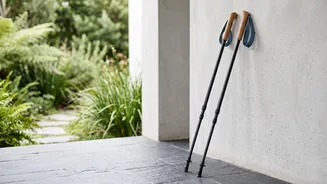
To begin, you'll need a pair of Nordic walking poles, which are different from trekking or hiking poles. Nordic poles are lighter and often feature a special glove-like strap system that allows for the proper push-and-release technique. Trekking poles are designed for stability and have different grips and tips. It's crucial to get poles that are the correct height for you; a general rule is that your elbow should be at a 90-degree angle when you hold the grip with the pole tip on the ground. While you can learn on your own, seeking out a certified instructor or a local walking group can be invaluable for mastering the correct form and avoiding common mistakes.