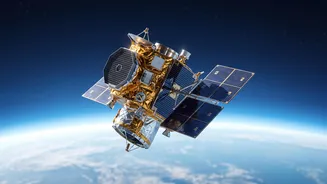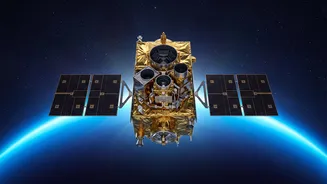


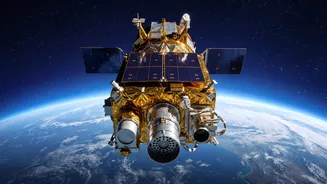

After an incredible 22-year career, one of NASA’s most agile cosmic detectives has taken its final bow. The Neil Gehrels Swift Observatory, which transformed our understanding of the universe's most violent explosions, met its end on November 4, 2026.
What Was the Swift Observatory?
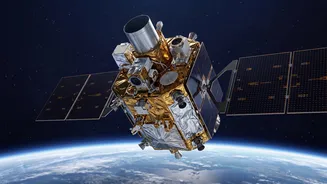
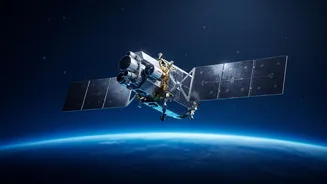
Launched on November 20, 2004, the Swift Observatory was a space telescope with a unique and vital mission: to hunt for gamma-ray bursts (GRBs). These are the most powerful explosions in the universe, believed to be caused by collapsing massive stars or the collision of dense neutron stars. The bursts are incredibly bright but fleeting, often lasting only seconds. Swift's name wasn't an acronym but a description of its key ability: speed. It was designed to detect a GRB and then autonomously 'swiftly' pivot its more sensitive telescopes—in X-ray, ultraviolet, and optical light—to the source in under 90 seconds. This rapid response allowed scientists, for the first time, to study the fading afterglow of these events in detail, unlocking clues about their origins and the distant universe.
A Legacy of Cosmic Discovery
Originally planned for a two-year mission, Swift far exceeded expectations, operating for nearly 22 years and revolutionizing multiple fields of astrophysics. It detected over 2,000 gamma-ray bursts, including one from 13.14 billion light-years away, giving us a glimpse into the universe when it was just over 500 million years old. In 2008, it made the first-ever observation of a supernova just as it was exploding. But its capabilities went beyond GRBs. Its agility made it a versatile 'multi-tool' for astronomy, studying everything from comets and asteroids in our solar system to stars being torn apart by black holes. Swift's data has contributed to roughly 7,000 scientific papers, cementing its legacy as one of the most productive observatories of its era.
Why Did the Mission End?
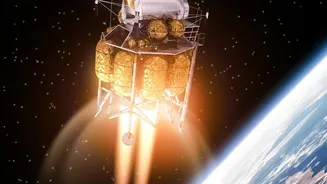
Like all satellites in low-Earth orbit, Swift constantly fought against atmospheric drag. The observatory had no engine to boost its orbit. This issue was dramatically accelerated by increased solar activity over the last couple of years. Intense solar flares caused Earth’s upper atmosphere to expand, creating more friction and pulling the spacecraft downward much faster than anticipated. NASA attempted a daring last-ditch rescue mission in July 2026, contracting a private company to send a robotic 'tug' to push Swift into a higher orbit. However, the rescue spacecraft suffered an attitude control malfunction and the attempt was abandoned in August, sealing Swift's fate. By October, its orbit had decayed to a point where it could no longer maintain a stable orientation for science, and the mission was officially terminated on October 23.
The Fiery Farewell on November 4
On the morning of November 4, 2026, the Swift Observatory finally succumbed to gravity. The U.S. Space Force confirmed that the 1,470 kg spacecraft re-entered Earth's atmosphere at 7:39 a.m. EST (12:39 UTC) over the North Sumatra region of Indonesia. As it plunged through the dense lower atmosphere at immense speed, most of the spacecraft was expected to burn up completely. However, NASA acknowledged that some durable components might have survived the fiery descent. The agency had calculated the risk of harm to anyone on the ground as approximately 1 in 2,100, a figure considered unlikely but not zero.