

A Star's Final Performance
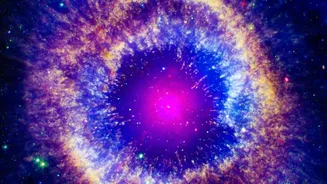
The subject of Webb's latest portrait is NGC 2392, a stunning object known as a planetary nebula. The name is a historical misnomer; these have nothing to do with planets. Instead, they are the elaborate, glowing shrouds of gas and dust ejected by a dying
star. When a star with a mass similar to our Sun runs out of fuel, its core becomes unstable. It sheds its outer layers into space, which are then illuminated by the intensely hot stellar remnant left behind, known as a white dwarf. This process creates the complex, filamentary shells that astronomers study to understand the final life stages of most stars in the universe. Discovered in 1787 by William Herschel, NGC 2392 has been nicknamed the Lion Nebula or Eskimo Nebula because of its resemblance to a face surrounded by a fur-lined hood.
Webb's Infrared Eyes
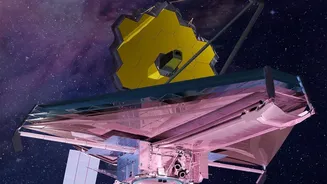
While the Hubble Space Telescope gave us breathtaking visible-light views of NGC 2392, Webb's strength lies in its ability to see the universe in infrared light. For this observation, it used two key instruments: the Near-Infrared Camera (NIRCam) and the Mid-Infrared Instrument (MIRI). Think of them as complementary tools for a more complete diagnosis. NIRCam is sensitive to shorter infrared wavelengths, which are excellent for seeing hotter, ionized gas and fine filamentary structures. MIRI, on the other hand, detects longer mid-infrared wavelengths, making it perfect for mapping the distribution of cooler dust. By combining data from both, astronomers can distinguish between different materials and temperatures within the nebula, creating a far more comprehensive picture.
What NIRCam Revealed: The Hot Gas
In the new images, NIRCam pierces through the nebula to reveal the intricate details of the hot, ionized gas. This gas forms a bubble, shaped by the fierce radiation and stellar winds blowing from the central white dwarf. The incredible resolution of NIRCam highlights the delicate, thread-like filaments within the inner shells of the nebula. These are areas where the ejected material is being powerfully shaped and sculpted. While looking similar in overall structure to Hubble's view, NIRCam's vision brings out features like dense clumps and a haze of ionized gas that are harder to discern in visible light. It essentially provides a high-definition look at the skeleton of the nebula, tracing the paths of the most energetic material as it expands outwards.
What MIRI Uncovered: The Cooler Dust
Switching to MIRI’s perspective is like putting on a different pair of glasses that reveals a hidden layer. MIRI’s view emphasizes the location of the cooler dust that makes up the nebula's outer regions—the lion's “mane.” This dust is what will eventually be recycled back into interstellar space, providing the raw material for future generations of stars and planets. The MIRI data shows dense, clumpy filaments of dust that have so far survived the destructive radiation from the central star. These clumps are important because they can shield the material behind them, allowing more complex molecules to survive in the harsh environment of the nebula. MIRI effectively maps the raw building blocks being expelled by the star, showing where they are most concentrated.
A More Complete Picture of Stellar Death
By combining the NIRCam and MIRI observations, scientists can now see the interplay between the hot, expanding gas and the cooler, clumpy dust. The composite image shows how the powerful outflow from the central star is simultaneously destroying some dust while illuminating the rest. This detailed map helps answer key questions about planetary nebulae, such as how their complex shapes are formed and how much material is returned to the cosmos. The structures seen in NGC 2392 are a snapshot in time; astronomers estimate the entire nebula will disperse in about 10,000 years—a blink of an eye in cosmic terms. This new view from Webb provides an unprecedented look at a process that our own Sun will undergo in about five billion years.