


Tesla’s Eyes on the Road
At the heart of Tesla's self-driving ambition is a system called Tesla Vision. Unlike many competitors that use a combination of cameras, radar, and LiDAR (Light Detection and Ranging), Tesla has committed to a vision-only approach. It uses a network
of eight cameras to create a 360-degree view around the car. This visual data is fed into a powerful neural network, which identifies objects like cars, pedestrians, and road markings, and predicts their movement to navigate. The system is designed to learn from the billions of miles driven by the entire Tesla fleet, constantly improving its ability to handle new situations. However, this learning is heavily based on data from more structured traffic environments, primarily in North America and Europe.
The Unpredictable Human Element
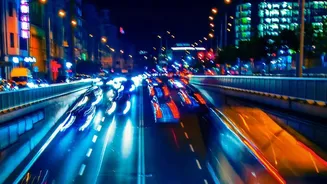
The first major hurdle for any autonomous system in India is the sheer unpredictability of human behaviour. On many Indian roads, lane markings are treated as suggestions rather than rules, with vehicles weaving to find the fastest path forward. Drivers, cyclists, and pedestrians often make sudden, unexpected movements. A recent viral video of a Tesla's screen in Gurugram traffic highlighted this, showing the system trying to track a dense and fluid mix of cars, bikes, and auto-rickshaws all squeezing into tight gaps. For an AI trained on orderly lane discipline, this constant improvisation is a nightmare. The system, which expects traffic to follow a predictable set of rules, is instead confronted with a scenario where the exceptions are the norm.
When a Cow Is Also Traffic
Indian roads are shared by a menagerie of users that go far beyond typical cars and trucks. Stray animals, particularly cows and dogs, are a common sight, often wandering into or resting in the middle of busy roads. While Tesla's system can detect pedestrians and cyclists, its training data may not be robust enough to predict the behaviour of a cow, which might stand still for a long time before moving suddenly. The system has to classify these animals correctly and predict their intent, a task vastly more complex than anticipating a car's movement. Add to this the diverse mix of vehicles—auto-rickshaws, handcarts, overloaded trucks, and countless types of two-wheelers—and the AI's object recognition task becomes exponentially harder. One report noted that even an Indian company's test system struggled to identify 15 percent of vehicles on local roads because of their varied configurations.
The Infrastructure and Data Deficit
Autonomous systems rely heavily on clear, consistent infrastructure. Tesla's Vision needs well-defined lane markings, standardized road signs, and relatively smooth road surfaces to orient itself and navigate effectively. Indian roads frequently lack these features. Lane markings can be faded or non-existent, signs may be obscured or inconsistent, and potholes are a common hazard that can be difficult for a camera-only system to correctly interpret, especially in poor weather like heavy rain or fog. This forces the AI to navigate based on the flow of other traffic, which, as established, is itself unpredictable. Without a reliable baseline of infrastructure, the system’s decision-making process is built on a shaky foundation. The very chaos of Indian roads is seen by some local developers not as a bug, but as a feature—a rich source of training data for building more robust systems from the ground up, an approach fundamentally different from adapting a system trained elsewhere.