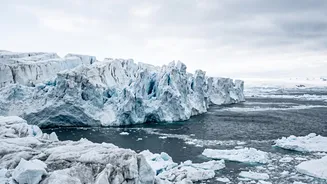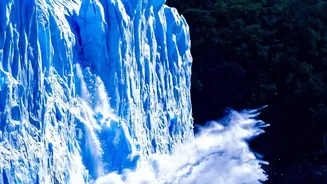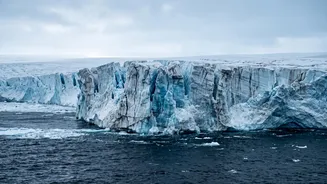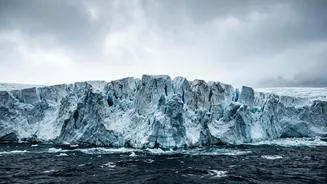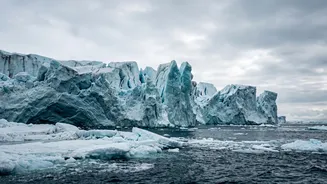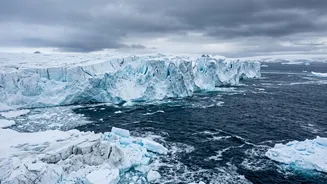




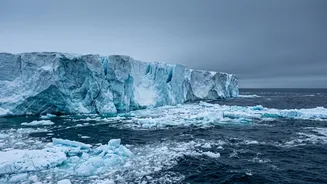
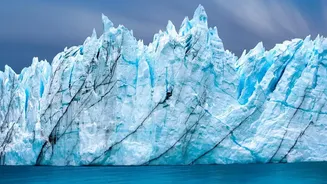
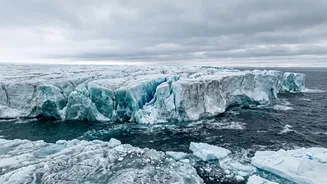
It’s nicknamed the 'Doomsday Glacier' for a reason. Antarctica's Thwaites Glacier holds enough ice to reshape coastlines globally. Now, a new model from leading scientists provides a much sharper, more concerning view of its future.
Why Thwaites Matters to Everyone
Covering an area roughly
the size of Great Britain or Florida, the Thwaites Glacier is one of the largest and fastest-changing glaciers in the world. It acts like a cork in a bottle, holding back a vast quantity of the West Antarctic Ice Sheet. If Thwaites were to collapse entirely, it alone could raise global sea levels by an estimated 65 centimetres, or over two feet. The ice sheet it currently restrains contains enough water to raise sea levels by a further two to three metres. For decades, scientists have watched this critical barrier thin and retreat at an accelerating pace, driven primarily by warm ocean water melting it from below. It already accounts for about 4% of current global sea-level rise, shedding ice at an astonishing rate.
What the New Model Found
Recent research from scientists at the University of California, Irvine, and NASA's Jet Propulsion Laboratory presents a sobering update. Their new computer model, detailed in the journal 'Nature Communications', projects that Thwaites could contribute up to 30 millimetres (1.2 inches) to global sea-level rise by the year 2100. This figure is roughly double what previous projections had estimated. What’s particularly alarming is that this elevated melt rate could occur even without any additional climate warming beyond what has already taken place. The findings suggest that past estimates may have significantly underestimated the risk, pointing toward a greater threat of coastal flooding in the coming decades than previously anticipated.
The Hidden Mechanism of Melting
The key to the new model's more dire prediction lies in how it understands the glacier's 'grounding zone'. This is the complex area where the ice transitions from resting on bedrock to floating on the ocean. Previous models often treated this as a simple, narrow line. However, satellite observations show it's a much wider zone, sometimes stretching for kilometres, where tidal forces can pump warm, salty ocean water deep beneath the grounded ice. By more accurately simulating this 'tidal pumping' mechanism, the new model shows that warm water is penetrating miles under the glacier, melting it vigorously from below and weakening its foundation. This improved understanding helps reconcile discrepancies between older models and real-world satellite observations, which have long shown the glacier changing faster than predicted.
A Critical Anchor Point at Risk
The accelerated melting has another dangerous consequence: it is weakening the glacier's connection to an underwater mountain called the Mouginot Ridge. This ridge currently acts as a crucial stabilising point, a natural brake slowing the glacier's slide into the sea. As the ice unpins from this ridge, it is expected to retreat much more quickly across the seafloor, which slopes downward into the interior of the continent, exposing ever more ice to warm ocean water. The new simulations predict a 60% probability that Thwaites will become detached from this critical ridge before the end of the century. Separate research has also shown that the glacier's retreat, which began around the 1940s, is now locked in for the foreseeable future, meaning ice loss will continue for at least the next 150 years regardless of our actions today.