




A Young Star in Our Cosmic Neighbourhood
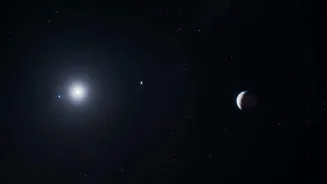
The Beta Pictoris system, located in the constellation Pictor, is a mere 63 light-years from Earth. In astronomical terms, that's just down the road. The star itself is very young, only about 23 million years old, compared to our Sun's 4.6 billion years.
This youth makes it a fascinating laboratory for studying planetary formation. Orbiting this star is Beta Pictoris b, a gas giant that dwarfs our own Jupiter, with a mass somewhere between nine and 13 times greater. Discovered in 2008, this 'super-Jupiter' has been a prime target for astronomers, and its recent activity has turned it into one of the most exciting objects in the sky.
A Signal from the Static
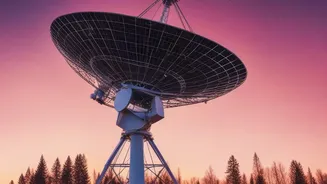
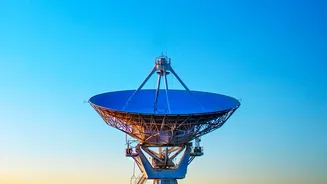
Using the powerful MeerKAT radio telescope array in South Africa, a team of astronomers detected faint but persistent radio bursts coming from the Beta Pictoris system. For a long time, the biggest challenge in such detections was proving the signal came from the planet itself and not its much louder host star. By using the precise positions of distant quasars as fixed reference points, the team successfully pinpointed the source: the radio waves were unambiguously coming from Beta Pictoris b. This marked the first time radio emission has been directly traced to an exoplanet, a landmark achievement in itself.
Not Aliens, but Auroras
Whenever radio signals from space are mentioned, the 'alien' hypothesis inevitably comes up. However, the science points to a far more grounded, and frankly more interesting, explanation. The detected radio signals were highly circularly polarised, a key characteristic of a process known as electron cyclotron maser instability. This is the very same physical process that generates auroral radio emissions from the planets in our own solar system, including Earth's spectacular Northern and Southern Lights. Auroras happen when charged particles, channelled by a planet's magnetic field, slam into its atmosphere, causing it to glow and emit radio waves. So, it's not an alien broadcast, but a planetary light show on a cosmic scale.
Why Auroras Are a Colossal Deal
The confirmation of auroras is far more significant than any fictional alien signal because it implies something crucial: Beta Pictoris b has a powerful magnetic field. Based on the frequency of the radio waves, scientists have calculated the planet's magnetic field to be at least 1,250 gauss—several thousand times stronger than Earth's. A planet's magnetic field, or magnetosphere, is a vital component for potential habitability. It acts as a protective shield, deflecting harmful stellar winds and cosmic radiation that would otherwise strip away a planet's atmosphere. While Beta Pictoris b is a gas giant and not a candidate for life, this discovery is a monumental proof-of-concept. It's the first direct measurement of an exoplanet's magnetic field, a crucial step toward understanding the environments of other worlds.
A New Era of Planet Hunting
This discovery doesn't just tell us about one planet; it opens a new window into studying all exoplanets. Previously, astronomers were limited to studying the size, mass, and orbits of distant worlds. Now, by listening for these auroral radio signals, they can start to characterise planetary magnetic fields across the galaxy. This provides a new tool to assess which planets might have the protective shields necessary to retain an atmosphere and, just maybe, foster life. It moves the search for habitable worlds beyond simply finding planets in the 'Goldilocks zone' and into a more nuanced understanding of what makes a planet a true home. The search isn't for messages anymore; it's for the fundamental planetary processes that make worlds what they are.