





An Unstable Foundation
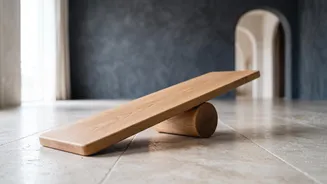
The most obvious challenge is the surface itself. Unlike solid ground, water is in constant motion. Every tiny ripple, gust of wind, or shift in your own weight creates a chain reaction that your body must counteract instantly. This dynamic instability
means your body can't rely on the fixed, predictable support it's used to. You are balancing on a platform that is constantly trying to tip, requiring continuous adjustments just to stay vertical. Beginners often find that their own over-corrections are what cause the wobbles to amplify; the brain, sensing a slight tip, sends a signal to lean the other way, but often too far, creating a wobble in the opposite direction.
Your Body's 'Sixth Sense'
This leads to the crucial role of proprioception, your body’s ability to sense its own position, movement, and orientation in space. Think of it as a 'sixth sense'. On stable ground, this system works quietly in the background. On a paddleboard, however, it's thrust into overdrive. Your feet, with their hundreds of small muscles and nerves, are constantly sending rapid-fire messages to your brain about the board's subtle tilts and movements. Your brain must then process this information and send immediate commands back to your muscles to adjust and maintain balance. This constant feedback loop is a form of intense sensory training, improving your body awareness and coordination in a way few other activities can.
A Full-Body Engagement
Staying upright on a paddleboard isn't just a job for your legs; it's a full-body commitment. While your legs and the small muscles in your feet act as the first line of defence against wobbles, your core is the central powerhouse of stability. The muscles of your abdomen, obliques, and lower back are constantly engaged to keep your torso stable over the board. From there, the engagement extends upwards. Every paddle stroke requires power from your back, particularly the lats, while your shoulders, biceps, and triceps control the paddle's movement through the water. This interconnected chain means that from your toes to your fingertips, nearly every muscle is working in concert to keep you balanced and moving.
The Power of Micro-Muscles
Many traditional workouts focus on large muscle groups, but paddleboarding shines a spotlight on the smaller, often-neglected stabiliser muscles. These are the deep muscles in your hips, core, ankles, and feet that are essential for joint stability and fine motor control. Because the surface is so unpredictable, these muscles are forced to make constant, tiny adjustments to prevent you from falling. This is why even fit individuals might feel a unique kind of fatigue or shaky legs after their first time on a board. They are waking up and strengthening a network of muscles that their regular fitness routine might not target. It's this deep muscle activation that makes paddleboarding such an effective tool for building functional strength and preventing injuries.