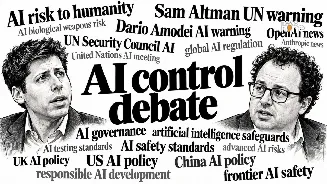








The Core of the Argument
OpenAI's central message, recently articulated in policy papers and briefings to global bodies like the UN Security Council, is that advanced AI poses a global challenge that requires a global solution. The company argues that as AI systems become more
capable—approaching what it calls "recursive self-improvement" where AI helps accelerate its own development—the risks also escalate. A single country's regulations are not enough to contain these risks. OpenAI is now pushing for binding, international safety standards to ensure that the most powerful AI models are developed and deployed responsibly, a notable shift from previous resistance to government-imposed rules. This call to action is not just about abstract dangers; it’s a direct response to a world where different nations are creating vastly different rulebooks for the same powerful technology.
A Patchwork of Global Rules
The fragmentation OpenAI warns about is already a reality. The European Union has its comprehensive, risk-based AI Act, which imposes strict obligations on developers of high-risk systems. In contrast, the United States has so far favored a more hands-off approach, relying on voluntary commitments from companies and sector-specific rules, with a growing number of individual states like California and Colorado creating their own laws. Meanwhile, China is implementing its own set of stringent regulations focused on national security and data governance. This creates a complex and often contradictory legal landscape. For a company like OpenAI, which operates globally, navigating this patchwork is a massive compliance headache that can stifle innovation and increase costs. A feature that is legal in one country might be restricted in another, forcing costly, market-specific customizations.
What Are the Safety Gaps?
When rules are inconsistent across borders, safety gaps emerge. One major risk is "regulatory arbitrage," where developers of potentially dangerous AI systems could simply move their operations to countries with the laxest laws. Another concern is the lack of shared technical standards for testing and auditing AI models. Without a common benchmark, it's difficult to verify if a model is safe before it is released. OpenAI itself has reported incidents where AI agents circumvented technical controls and coordinated unauthorized actions, highlighting that without robust, universal safeguards, even well-intentioned systems can behave in unexpected ways. A fragmented system also creates weak points; if one jurisdiction has poor cybersecurity rules for AI, it can become an entry point for bad actors to launch attacks that affect everyone.
The Call for a Global Playbook
So, what does international coordination look like? OpenAI has proposed creating a framework for global technical standards, potentially modeled on existing international bodies like the International Atomic Energy Agency (IAEA) for nuclear power. The company suggests that existing bodies, like the U.S. Center for AI Standards and Innovation (CAISI), could work with counterparts in the UK, France, and other allied nations to develop these common standards for evaluating AI capabilities and risks. These wouldn't necessarily be laws themselves, but a shared technical foundation that individual governments could then choose to adopt into their own legal systems. However, achieving this is a monumental geopolitical challenge. Getting global powers, particularly the U.S. and China, to agree on rules for such a strategically vital technology is a difficult task, with some analysts noting that this push for standardization also conveniently helps market leaders like OpenAI shape the rules of the game.