









A Landmark Success in the Rearview Mirror
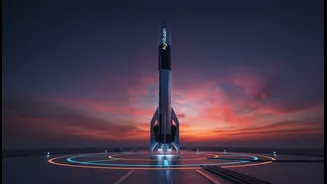
It’s impossible to discuss Agnikul’s next steps without acknowledging the significance of its first. The launch of the 'Agnibaan SOrTeD-01' (Suborbital Tech Demonstrator) was a watershed moment for India's private space sector. On May 30, 2024, the company
successfully flew a single-stage rocket powered by the world's first single-piece 3D-printed engine, the Agnilet. The flight, which lasted just over a minute, was not about reaching orbit; it was a crucial test to prove that the core technology worked as designed in real-world conditions. By all accounts, the mission was a resounding success. It collected vital flight data, validated the engine's performance, and demonstrated the viability of Agnikul's unique design and manufacturing approach. This achievement catapulted the Chennai-based startup into a select group of global companies that have designed, built, and launched their own privately funded rockets.
From a Sprint to a Marathon
So why the relative silence since that historic day? The simple answer is that space is hard, and the leap from a short, suborbital test to a full-fledged orbital mission is monumental. The first flight was a controlled experiment to test the most critical component. Now, Agnikul's engineering teams are meticulously analyzing the treasure trove of data gathered during SOrTeD-01. Every millisecond of the flight provides insights into aerodynamics, engine performance, structural integrity, and avionics. This data is being used to refine simulations and hardware for what comes next. Unlike software, you can't simply patch a rocket in mid-air. The 'measure twice, cut once' philosophy is a fundamental principle of aerospace engineering, and this intensive post-flight analysis is a non-negotiable part of the process. Announcing a premature launch date would be counterproductive to this methodical, safety-critical work.
What Could Mission-02 Look Like?
While Agnikul has not officially detailed the objectives for Mission-02, the logical progression in rocketry suggests it will be another incremental, yet far more ambitious, step. The ultimate goal for the Agnibaan rocket is to be an orbital-class vehicle capable of delivering small satellites weighing up to 300 kg to low Earth orbit. The first flight was a vertical ascent to a modest altitude. A second mission would likely aim to test the vehicle under more stressful conditions. This could involve a longer flight, reaching a higher altitude, and testing stage separation mechanisms if a two-stage configuration is used. It would also be an opportunity to test the vehicle's guidance and control systems over a longer duration. Each successful test builds confidence and moves the company closer to its first commercial orbital launch, which is the true end goal and the key to unlocking its business model.
The Strategic Value of Waiting
In the fast-paced world of startups, a lack of news can sometimes be misinterpreted as a lack of progress. However, in the capital-intensive and high-stakes domain of space technology, strategic patience is a virtue. Agnikul is not just building a rocket; it is building a reliable launch service. A public failure is exponentially more damaging than a quiet delay. By taking its time, the company manages expectations for its investors, future customers, and the public. It also allows the team to work without the immense pressure of an arbitrary deadline, which can lead to costly mistakes. The current phase of development involves rigorous ground testing of upgraded components and integrated systems. This is the unglamorous but essential work that ensures the next flight has the highest possible chance of success.
Navigating India’s New Space Race
Agnikul’s journey is not happening in a vacuum. It is a leading player in India’s burgeoning private space industry, a sector actively encouraged by the government and its space agency, ISRO. This ecosystem is buzzing with activity, with competitors like Hyderabad-based Skyroot Aerospace also making significant strides. Skyroot, for instance, has already conducted its own suborbital launch and is developing its Vikram series of rockets for orbital flights. This competitive dynamic adds another layer of complexity to Agnikul's strategy. While there is a race to be the first and most reliable launch provider for the small satellite market, the primary race is against the physics of rocket science itself. Getting it right is far more important than getting it done quickly, as the long-term success of the company and the reputation of India's private space capabilities are on the line.