








A Surge of Unprecedented Scale
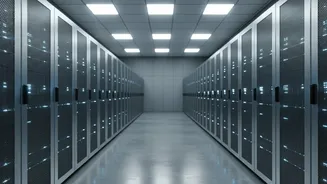
India is currently witnessing a data centre construction boom of historic proportions. The country's installed capacity, which stood at roughly 950 megawatts (MW) in early 2024, is projected to nearly double to around 1,800 MW by the end of 2026. Some
forecasts are even more ambitious, predicting capacity could quadruple to over 6.5 gigawatts (GW) by 2030. This expansion is fueled by staggering investment, with a planned pipeline of nearly $90 billion—a figure that dwarfs the $13-15 billion invested between 2020 and 2024. This breakneck growth reflects a simple reality: while India generates around 20% of the world's data, it currently holds only about 3-4% of global data centre capacity, highlighting a massive gap that companies are now scrambling to fill.
The Triple Engine of Demand
Three powerful forces are driving this insatiable demand for data infrastructure. First is the sheer volume of data being created by nearly a billion internet users, the rollout of 5G, and the widespread adoption of digital services from UPI payments to OTT streaming. Second is the enterprise-level shift to cloud computing, with businesses of all sizes migrating their operations online. Third, and perhaps most significantly, is the rise of Artificial Intelligence. AI workloads require immense computational power and generate enormous datasets, necessitating a new generation of high-density, AI-ready data centres.
The Hyperscaler and Policy Effect
A huge portion of this new capacity is being built to serve 'hyperscalers'—tech giants like Amazon Web Services (AWS), Microsoft Azure, and Google Cloud. These companies are pouring billions into establishing and expanding their cloud regions across India to offer faster, more reliable services to local customers. Their expansion is further encouraged by government policies. The Digital Personal Data Protection Act and other data localisation mandates require certain types of data to be stored within India's borders, effectively making domestic data centres a legal and operational necessity for any global firm operating in the country.
The Contenders in the Arena
The race for capacity involves a mix of global giants and homegrown champions. International players like Equinix, NTT, and Digital Realty are expanding their Indian footprint aggressively. They are competing with and partnering with domestic powerhouses. These include players like Nxtra (backed by Bharti Airtel), Yotta Data Services, CtrlS Datacenters, and AdaniConneX, a joint venture between Adani Group and EdgeConneX. Most of the action is concentrated in hubs like Mumbai, which has emerged as a top data centre market in the Asia-Pacific region, followed by Chennai, Hyderabad, Bengaluru, and the Delhi-NCR region.
Growing Pains and Future Challenges
This rapid expansion is not without its challenges. Data centres are incredibly power-hungry, and ensuring a reliable supply of electricity—increasingly, green energy—is a major hurdle. The electricity demand from data centres is expected to surge more than tenfold by the early 2030s. Access to large parcels of land in prime locations and a sufficient supply of water for cooling are also critical constraints. Furthermore, the industry faces a shortage of skilled talent needed to design, build, and operate these highly complex facilities. Overcoming these bottlenecks will be crucial for the sector to sustain its incredible momentum.