


A Celestial Lion Roars into View
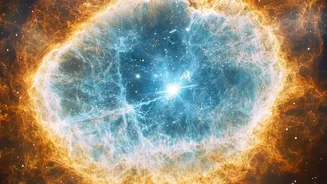
Known as the Lion Nebula for its striking resemblance to a lion's head, NGC 2392 offers a dramatic glimpse into the future of stars like our own Sun. Located thousands of light-years away in the constellation Gemini, this object is a planetary nebula—the
expanding, glowing shells of gas and dust shed by a star in its final life stages. While the Hubble Space Telescope gave us breathtaking views in visible light back in 2000, the James Webb Space Telescope (JWST) has now provided a significantly sharper and more detailed perspective in the infrared spectrum. This new portrait, a composite of images from Webb’s Near-Infrared Camera (NIRCam) and Mid-Infrared Instrument (MIRI), cuts through the cosmic dust to reveal the intricate physics at play.
What Webb's Infrared Vision Reveals
The power of the Webb telescope lies in its ability to see the universe in infrared light, which is invisible to the human eye. This capability allows it to peer through clouds of dust that obscure the view of other telescopes like Hubble. In the case of the Lion Nebula, this has unveiled incredible new details within its structure. The image highlights a complex scene where a super-hot central star, known as a white dwarf, is fiercely sculpting its surroundings. Webb’s view clearly distinguishes the cavernous bubbles and shells of ionised gas that form the lion's 'face' from the sprawling 'mane', which is an illuminated shell of dust. Most impressively, it details compact clumps of dust that have so far survived the intense radiation from the central star, appearing as fiery red and orange filaments that protect the material hiding behind them.
The Anatomy of a Dying Star
Planetary nebulae are beautiful but fleeting cosmic events. They are formed when a low-mass star, like our Sun, exhausts the nuclear fuel in its core. The star becomes unstable, shedding its outer layers into space. The remaining core, now a blistering hot white dwarf, unleashes powerful radiation and stellar winds. This outflow slams into the previously ejected, slower-moving material, creating the complex shapes we observe. In NGC 2392, the central star's radiation is 'cooking' the surrounding gas, causing it to glow and expand. This process carves out the inner bubble of the nebula while illuminating the outer regions. Studying these structures helps astronomers understand the final, chaotic chapters of stellar evolution and how stars enrich the cosmos with heavier elements.
A Moment Frozen in Time
The stunning image from Webb captures a snapshot of a process that has been unfolding for thousands of years. The structures we see are not static; the gas and dust are continually expanding and migrating away from the central star. The intricate patterns of filaments, shells, and comet-like tails are a direct result of the battle between the star's destructive radiation and the resilient clumps of dust. Astronomers estimate that in about 10,000 years, the Lion Nebula will have dispersed entirely into interstellar space, a relatively brief lifespan in cosmic terms. This makes Webb’s detailed observation invaluable, providing a precise reference point to test and refine models of how these beautiful objects evolve and eventually fade away.