





Not a Rainbow, Not from Fire
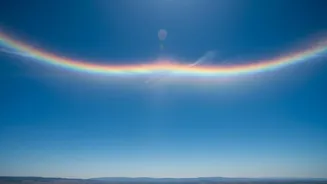
First things first, let's clear up the name. The term 'fire rainbow' is a catchy, but misleading, nickname for a phenomenon scientists call a circumhorizontal arc. These arcs have no connection to fire; the name likely comes from their flame-like appearance
when seen in wispy, fragmented clouds. They also aren't rainbows. A true rainbow is formed by sunlight being refracted and reflected by liquid water droplets, and it always appears in the part of the sky opposite the sun. A circumhorizontal arc, however, is a type of ice halo formed by the refraction of light through ice crystals, and it always appears on the same side of the sky as the sun, parallel to the horizon.
A Perfect Recipe of Sun and Ice
So, how does this beautiful display happen? It requires a very specific set of ingredients to come together perfectly. First, you need high-altitude cirrus clouds, which are composed of millions of tiny, hexagonal (six-sided) ice crystals. Second, these plate-shaped ice crystals must be aligned horizontally, like tiny floating dinner plates suspended in the atmosphere. Finally, and most critically, the sun must be very high in the sky—at an elevation of more than 58 degrees above the horizon. When these conditions are met, sunlight enters the vertical side of an ice crystal and exits through the bottom horizontal face. This journey bends the light, splitting it into its constituent colors like a prism, creating the vibrant, horizontal spectrum we see. Red is always the topmost color, with violet at the bottom.
NASA’s Stunning New View
The recent buzz was kicked off by NASA's Astronomy Picture of the Day (APOD) for August 2, 2026, which featured a spectacular circumhorizontal arc. While the photo itself was taken previously over West Virginia, its feature on APOD brought this optical wonder to a global audience, complete with a clear explanation of the science. Such images from NASA are invaluable. They not only provide breathtaking views but also serve as a public education tool, helping to distinguish between different atmospheric phenomena and explain the physics behind them in an accessible way. These high-quality captures allow everyone to appreciate the precise alignment of sun and ice crystals required to paint such colors across the sky.
Why Understanding Optics Matters
Knowing the science behind a 'fire rainbow' doesn't diminish its magic—it enhances it. Understanding atmospheric optics helps us appreciate the intricate dance of light and matter. Without this knowledge, it’s easy to confuse a circumhorizontal arc with other phenomena like cloud iridescence, which is caused by diffraction rather than refraction and can appear in different types of clouds and positions in the sky. By checking for the key optical indicators—a high sun, the presence of cirrus clouds, and the horizontal, rainbow-like band below the sun—we can correctly identify what we're seeing. This prevents misinterpretation and deepens our appreciation for the specific, rare conditions that create such a breathtaking sight.
How to Spot One Yourself
Want to see a circumhorizontal arc in person? Your chances are best during the summer months in mid-latitude locations, like much of the United States. The phenomenon is impossible to see at latitudes north of 55°N or south of 55°S because the sun never gets high enough in the sky. The key is to look for thin, wispy cirrus clouds during the middle of a clear day, when the sun is at its highest point. The arc will appear as a colorful band parallel to the horizon, a good distance below the sun. Wearing polarized sunglasses can help make the colors pop, especially if the arc is faint. While they are considered rare, knowing when and where to look dramatically increases your chances of spotting one.