

The Science of a Shrinking Ocean
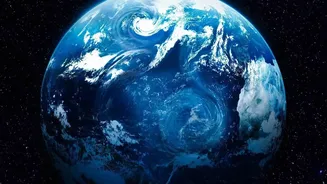
The reason for the Pacific’s gradual disappearance lies in the relentless engine of plate tectonics. Earth’s crust is not one solid piece but a mosaic of shifting plates. New oceanic crust is born at mid-ocean ridges where magma rises, while old crust is destroyed
at subduction zones, where one plate dives beneath another and melts back into the mantle. The Atlantic Ocean is primarily expanding, but the Pacific is surrounded by the “Ring of Fire,” a vast chain of subduction zones that consumes crust faster than it can be created. This geological recycling process is causing the Pacific basin to contract by a few centimetres each year. While that sounds minuscule, over geological time, it means the world’s mightiest ocean is on a long, slow path to extinction.
Meet Amasia, The Next Supercontinent
Scientists run complex simulations to forecast the Earth's deep future. A leading theory, put forward by researchers at Australia's Curtin University, used supercomputer modelling to show that the closure of the Pacific is the most likely path to our planet's next great merger. This future landmass has been named Amasia, a portmanteau of America and Asia. In this scenario, Australia will first drift north and collide with Asia, before the Americas are pulled westward across the shrinking ocean to eventually crash into the newly formed mega-continent. This process is part of the Earth's supercontinent cycle, which has seen landmasses consolidate and break apart roughly every 600 million years for the last two billion years. The last one, Pangaea, broke up around 200 million years ago, creating the world map we know today.
A World Already Bridging the Gap
While the physical merger of continents is an event for the distant future, the economic and cultural convergence across the Pacific is happening now. The term "Asia-Pacific" is more than a geographic label; it represents one of the most dynamic economic zones on the planet. Supply chains, once stretching across the Atlantic, are now deeply rooted across the Pacific, linking factories in Asia with consumers in the Americas. Trade agreements and economic partnerships are constantly being forged, creating a web of interdependence that effectively shrinks the distance between nations. This integration isn't just about shipping containers and balance sheets. It's about the flow of ideas, the fusion of cultures, and the shared challenges, from economic stability to regional security, that force nations on both sides of the ocean into closer dialogue and cooperation.
The New Center of Gravity
For centuries, the Atlantic was the centre of global power and commerce. That era is fading. Today, the world's economic and demographic centre of gravity is shifting decisively toward the nations bordering the Pacific. This isn't just about the rise of China, but a broader dynamism that includes Japan, South Korea, the ASEAN nations, and growing economies in Latin America looking west instead of east. This shift brings both opportunities and friction. As the continents drift closer geologically, they also move into more direct strategic competition. The United States, a long-time Pacific power, is recalibrating its foreign policy to address a region that is more crowded, more competitive, and more critical to global prosperity than ever before. The shrinking of the Pacific is, in this sense, a metaphor for a world where powers must learn to coexist in a smaller, more interconnected space.
An Inhospitable Future?
Looking ahead to the formation of Amasia reveals a world drastically different from our own. Scientists predict that a single supercontinent would create profound environmental changes. With the vast Pacific Ocean gone, its role as a global climate regulator would disappear. The interior of Amasia would likely be an immense, arid desert with extreme temperature swings, potentially making it hostile to many forms of life. Sea levels would be lower, and biodiversity could plummet as distinct ecosystems are forced together. The collision of continents would also trigger intense volcanic activity and earthquakes on a massive scale. This vision of a harsh, challenging future world serves as a humbling reminder of the immense geological forces that shape our planet, operating on timescales that dwarf human history.